
Reviewed · AMSTERDAM HISTORY WALKING TOURS
Amsterdam: World War II Private Walking Tour
Amsterdam’s wartime story comes alive not in a museum case, but along the canals and side streets where occupation, resistance, and persecution unfolded. This private walk links important sites from 1940 to 1945, with guides Ben de Jong and Peter Schaapman explaining what Amsterdam looked and felt like under Nazi control. The route is serious, personal, and firmly focused on the city itself.
I like the private format, which keeps the pace and questions within your own group. I also like that the walk goes beyond the most famous address, leading you through lanes and alleyways that are easy to miss on your own. The main drawback is that it does not include entry to the Anne Frank House, the Resistance Museum, or the Hollandsche Schouwburg.
Key points to know
- A private three-hour walk: Your group alone takes part, with a maximum of four people.
- A strong local focus: The tour examines Amsterdam during the Nazi occupation from 1940 to 1945.
- Led by named historians: Ben de Jong and Peter Schaapman guide the experience.
- Important memorial stops: The walk includes the Monument to Jewish Resistance and ends at the National Holocaust Names Monument.
- A pause halfway through: You get time for coffee and a restroom stop, although the drink itself is not included.
- Best for mature children and adults: The suggested minimum age is 13 because of the subject matter.
Amsterdam’s wartime story begins on Prinsengracht
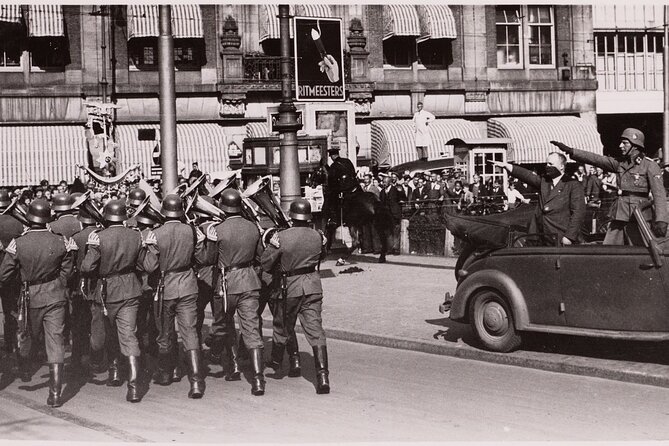
The tour starts at Prinsengracht 263 at 9:30 a.m. This is the address associated with the Anne Frank House, but the walking tour does not include museum admission or a visit inside the house. That distinction matters, especially if you are building a full day around Amsterdam’s World War II sites.
From here, the walk turns toward the history of Nazi-occupied Amsterdam. The central question is not only what happened during the war, but how occupation changed daily life in the city. You learn about the pressure of Nazi rule, the persecution of Jewish residents, and the resistance that developed in response.
Because this is a private activity, you can ask for clarification when a name, location, or event needs more explanation. A large group often moves on before a question has been answered. Here, the guide can adjust the pace to your interests, within the roughly two-and-a-half to three-hour schedule.
The guides are Ben de Jong and Peter Schaapman. Peter Schaapman is described as a published historian, and the experience places real weight on his storytelling. One particularly useful feature is the attention to ordinary streets and narrow lanes, not just grand monuments. That helps you picture the city as a place where people lived, worked, hid, resisted, and made difficult choices.
More history walks in Amsterdam:
- Amsterdam: Life of Anne Frank and World War II Walking Tour
★ 4.8 · 10,467 reviews - Amsterdam: Dutch WWII Resistance Museum Entry Ticket
★ 4.7 · 951 reviews - Amsterdam High-End Dutch Food & History Tour – Up to 8 guests
★ 5.0 · 482 reviews
Following the occupation through side streets and monuments
The route visits important places and monuments connected with the Nazi occupation of Amsterdam. Only one formal stop is named in the details, the Monument to Jewish Resistance, but the walk also takes you through streets and alleyways tied to the period.
That approach gives the tour a different feel from a museum visit. You are not moving from one display panel to another. Instead, the guide uses the physical city as the setting for the story. The streets become reference points, helping you understand how close different parts of wartime Amsterdam were to one another.
The subject is traumatic, and the tour does not treat it as light sightseeing. The suggested minimum age is 13, a useful warning for families. Younger children may find the material difficult, while teenagers with a serious interest in history may find the format more engaging than a conventional lecture.
You should also expect walking on city streets for most of the three hours. A moderate level of physical fitness is recommended. The route includes a short break about halfway through for coffee and a restroom visit, but coffee or tea is not included in the price.
The Monument to Jewish Resistance
The Monument to Jewish Resistance is the clearest named focus of the walk. Its importance comes from the way it links memory, persecution, and opposition to Nazi rule. The guide uses the site to explain the role of Jewish resistance and to place the monument within Amsterdam’s wartime story.
This is not simply a stop for a photograph. The value comes from having a guide explain what the memorial represents and how it relates to the wider events of the occupation. You can expect the discussion to deal with loss and moral pressure, as well as with the acts of resistance that shaped the period.
The tour’s wording points to an important balance: it is about the Nazi occupation, but it also considers the continuing legacy of the Second World War. That makes the memorial relevant beyond 1945. You are encouraged to think about how a city remembers persecution, resistance, and the people affected by both.
If you want a quick list of dates and famous names, this may feel slow. If you want to understand how a city carries its wartime past, the stop has more weight. The private setting is especially helpful here, since you can pause and ask questions without holding up a larger group.
What the tour leaves out, and why that matters
This experience does not visit the Anne Frank House, the Resistance Museum, or the Hollandsche Schouwburg, which served as a deportation center. Tickets to those places are not included, and you should not treat this walk as a substitute for them.
That is a limitation, but it also keeps the tour focused. You spend the time walking through Amsterdam rather than waiting for museum entry or moving through indoor exhibits. I would see this as a city-based introduction that works best alongside, rather than instead of, one of Amsterdam’s major wartime museums.
The meeting point at Prinsengracht 263 can make planning slightly confusing because it is associated with the Anne Frank House. You should arrive expecting to meet the walking guide outside, not to enter the museum as part of this experience. If you want to visit the Anne Frank House separately, you need a separate ticket.
The same applies to the Resistance Museum and Hollandsche Schouwburg. The walk gives historical context, but it does not cover admission to those sites. If these places are priorities, plan them independently and allow enough time for each.
More walking tours in Amsterdam:
- Anne Frank’s Story – Guided Walking Tour through Amsterdam
★ 5.0 · 11,619 reviews - Absolutely Amsterdam – the Essential Introductory Walking Tour
★ 5.0 · 3,629 reviews - Amsterdam: Anne Frank Guided Small Group Walking Tour
★ 4.8 · 2,722 reviews - Amsterdam: Anne Frank Walking Tour – Guided in EN/DE/IT/ES
★ 4.9 · 2,676 reviews
A private format for serious questions
The tour is limited to your own group, with the stated price of $180.04 for up to four people. That works out to about $45 per person if four people share the cost, though the total value changes if you are a smaller group.
For one person, the price is substantial. For two people, it is still a premium walking tour. For three or four people, the private arrangement becomes easier to justify because you are paying for a three-hour guide rather than buying four separate places on a group excursion.
The strongest value is personal attention. You can ask about a particular site, request more explanation, or spend a little longer on a point that matters to you. The tour is also offered in English and German, which helps if one of those languages is more comfortable for your group.
The experience is booked an average of 54 days ahead, so it is sensible to reserve early if your Amsterdam dates are fixed. That does not mean every date will sell out, but it does show that people often plan this activity well before arrival.
All fees and taxes are included. Coffee and tea are not. Since the halfway stop is intended for a short break, you should bring a little money if you want a drink.
Why the guides make the difference
A wartime walking tour depends heavily on the person leading it. The streets cannot tell the full story by themselves. You need someone who can connect places, decisions, and consequences without turning the walk into a dry list of dates.
Ben de Jong and Peter Schaapman are the named guides. Peter is also described as a published historian, and the tour places emphasis on his ability to explain the period in a clear, engaging way. The guide’s role is especially important because much of the experience happens outdoors, without museum panels or objects to carry the story.
The strongest praise centers on Peter’s ability to lead people into lesser-known lanes and describe what life was like under Nazi control. That is a useful clue about the tone. You should expect a detailed, human account rather than a rushed checklist of landmarks.
At the same time, the guide cannot change the nature of the subject. This is a sober experience. The walk may be fascinating, but it is not cheerful entertainment, and the content can be upsetting. The age recommendation of 13 is there for a reason.
Timing, walking comfort, and practical planning
The tour starts at 9:30 a.m. and lasts about three hours. A morning start gives you the rest of the day for other plans, including a museum visit or a separate appointment at the Anne Frank House.
You should wear comfortable shoes. The experience is a walking tour, and a moderate level of physical fitness is recommended. No special equipment is listed, but Amsterdam weather can change, so clothing that works for a few hours outdoors is sensible.
The route ends at the National Holocaust Names Monument, listed at 1018 DP Amsterdam. This is not the same location as the starting point, so plan to finish your day from the endpoint rather than assuming you will return to Prinsengracht.
The tour is near public transportation, and service animals are allowed. A mobile ticket is provided, and confirmation arrives when you book. You can cancel for a full refund up to 24 hours before the start time. Cancellations or changes made later are not accepted, with cut-off times based on local Amsterdam time.
Who will get the most from this walk
I would recommend this tour to adults and teenagers who want a focused look at Amsterdam during the Second World War. It suits people who prefer a guide-led walk to a museum-only visit and who want to connect memorials with the streets around them.
It is also a good choice for a small family or group of friends. Four people can share the private fee, ask their own questions, and keep the pace comfortable. History students, amateur researchers, and visitors with a particular interest in occupation and resistance will likely find the format worthwhile.
You may want to choose another activity if you want a broad introduction to Amsterdam, a light sightseeing walk, or a tour with major indoor attractions included. This is not a general city tour. Its subject is narrow, serious, and tied closely to the Nazi occupation.
I would also think carefully before booking it for young children. The minimum age is suggested rather than presented as a strict admission rule, but the content concerns persecution, deportation, and wartime trauma. Older children may benefit from it, while younger ones may not.
My take on the $180.04 group price
The price makes the most sense when four people share it. At that size, you get a private three-hour experience for roughly $45 each, with all fees and taxes included. That is reasonable for a specialist historical walk led by a named guide.
For a couple, you are paying more per person, but the private format has real benefits. You avoid a large group, can ask questions freely, and receive a more direct explanation of the sites. For a solo visitor, the cost is harder to defend unless this subject is one of your main reasons for visiting Amsterdam.
The missing museum tickets should also be part of your budget. If you want the Anne Frank House, Resistance Museum, or Hollandsche Schouwburg, you will pay separately and need to plan those visits on your own.
My advice is to judge the price against your interest in the topic. If you want a specialist guide and a serious walk through the wartime city, the cost can be worthwhile. If you mainly want famous attractions and general sightseeing, spend the money elsewhere.
Should you book this Amsterdam World War II walk?
Book it if you want a private, serious examination of Amsterdam under Nazi control, especially if you value lesser-known streets, memorials, and time for questions. The Monument to Jewish Resistance, the final stop at the National Holocaust Names Monument, and the focus on the war’s continuing legacy give the experience a clear purpose.
I would book early, particularly if your dates are fixed, and I would arrange museum visits separately. Choose this walk for historical context and personal guidance, not for entry to Amsterdam’s main wartime museums.
For four people with a strong interest in the subject, it offers good value. For a solo visitor or anyone seeking a lighter city tour, the price and serious tone may not be the right fit.
FAQ
How long does the World War II walking tour last?
The tour lasts approximately three hours, with the full walk taking about two and a half to three hours.
What time does the tour begin?
The tour starts at 9:30 a.m.
Where does the tour start?
It starts at Prinsengracht 263, 1016 GV Amsterdam, Netherlands.
Where does the tour end?
The walk ends at the National Holocaust Names Monument, listed at 1018 DP Amsterdam.
Is the tour private?
Yes. Only your own group takes part, and the price covers up to four people.
Does the tour include the Anne Frank House or other museums?
No. The tour does not visit the Anne Frank House, the Resistance Museum, or the Hollandsche Schouwburg. Museum tickets are not included.
Is coffee included during the break?
No. A short break is provided about halfway through for coffee and a restroom visit, but coffee and tea are not included.
Newest Amsterdam write-ups
- Guided Bike Tour along the Dutch Tulip Fields in Noord Holland★ 5.0 · 9 reviews
- IJmuiden to Amsterdam Private Transfer★ 5.0 · 6 reviews
- Zaanse Schans and Giethoorn Unique Day Trip with Boat Cruise★ 4.5 · 17 reviews
- Half-Day Private Guided Sightseeing Tour of Zaanse Schans★ 5.0 · 14 reviews
- Amsterdam to Schiphol Airport Transfer Comfort & service.★ 5.0 · 6 reviews
- Zaanse Schans Private Tour Windmills★ 5.0 · 18 reviews
- Bike tour in Amsterdam with an Italian guide★ 5.0 · 15 reviews
- Private Tour Zaanse Schans Windmills and Volendam in Jaguar★ 5.0 · 10 reviews
Amsterdam History Walking Tours, compared.
Life of Anne Frank and World War II Walking Tour
Read our review →

Amsterdam High-End Dutch Food & History Tour – Up to 8 guests
Read our review →
Anne Frank and Amsterdam Jewish History Walking Tour
Read our review →
Small Group Tour to Nazi WWII concentration camp from Amsterdam
Read our review →
Anna Frank and World War II History Walking Tour
Read our review →Browse the lists this tour appears in