
Reviewed · AMSTERDAM WALKING TOURS
Absolutely Amsterdam – the Essential Introductory Walking Tour
Amsterdam’s story is unusually easy to read from the street. On this walk, a former stock exchange, a hidden Catholic church, a market in the old Jewish Quarter, and crooked canal houses become chapters in one lively lesson about water, trade, tolerance, religion, and survival.
I like the wide range of subjects and the way the route links them. I also like the small-group limit of 15 people, which gives a guide room to answer questions and keep the pace human. Guides such as Raymond, Jaap, Sergio, and Fernando are repeatedly praised for humor, clear storytelling, and useful suggestions for the rest of your stay.
The main consideration is that this is an outdoor history walk, not a museum tour. You see the outside of Our Lord in the Attic Museum rather than entering, and the advertised two and a half hours can feel long if the weather turns poor or crowded streets slow the group.
Key points at a glance

- A strong first look at old Amsterdam: The route connects Damrak, Chinatown, Waterlooplein, the Amstel, and Dam Square.
- History with some edge: Expect frank discussion of prostitution, drug policy, religious tolerance, colonial trade, the Nazi occupation, and the city’s Jewish past.
- Mostly free sights: The walk does not include admission to the hidden church, the Waag, or the Royal Palace.
- A practical orientation: You’ll learn how canal houses, bicycles, markets, and the old harbor shaped daily life.
- Pay-what-you-like value: The listed price is only $5.93 per person, making this an inexpensive way to get your bearings.
- A manageable group: The maximum is 15 people, and the walking pace is generally described as easy.
Why this makes a smart first walk in Amsterdam
Amsterdam is compact in the old center, but its story is not simple. A pretty canal may also reflect ambitious land reclamation. A church may point to centuries of religious compromise. A narrow house may reveal old taxes, trade customs, and practical problems with soft ground.
This tour gives you those connections before you spend time visiting individual museums. You move from the old harbor to the center of political power, then through neighborhoods shaped by religion, commerce, war, and changing laws. I like that approach because you are not just ticking off sights. You are learning how the city works.
The walk lasts about 2 hours and 30 minutes. That is enough time to cover a lot without turning the outing into a full-day commitment. Several guides, including Raymond, Jaap, and Sergio, are praised for keeping the pace comfortable while still fitting in plenty of information.
You should still wear good walking shoes. The route has many stops, but it remains a city walk on busy streets, and bicycles can appear from every direction. Crowded periods may also make it harder to hear or keep close to the group.
More walking tours in Amsterdam:
- Anne Frank’s Story – Guided Walking Tour through Amsterdam
★ 5.0 · 11,619 reviews - Amsterdam: Life of Anne Frank and World War II Walking Tour
★ 4.8 · 10,467 reviews - Amsterdam: Anne Frank Guided Small Group Walking Tour
★ 4.8 · 2,722 reviews
Beurs van Berlage and the city built on water
The walk begins at Beursplein 5, in front of the Beurs van Berlage. This is a useful starting point because Amsterdam’s origins are tied to both water and money.
The exchange buildings occupy ground where the Amstel once flowed. Here, the guide explains how the settlement developed and how the river, harbor, and financial trade helped shape the city. The stop lasts about 20 minutes and costs nothing to enter because the discussion takes place outside.
This opening gives you a framework for the rest of the walk. Amsterdam was not simply a charming town that happened to acquire canals. Water shaped transport, defense, land use, and trade. Finance then helped turn a port city into a major commercial power.
Damrak and the holy, profane old harbor
From the exchange buildings, you continue to Damrak, the old harbor area. This is one of the more complicated parts of the route because the discussion moves beyond postcard scenery.
You learn how the Red Light District developed, how the Church fit into the neighborhood, and how religious institutions and commercial activity sometimes existed side by side. The guide also covers the legal status of prostitution, including how and why it became a profession recognized by the state.
The stop lasts about 15 minutes. You should expect direct discussion rather than a sanitized version of Amsterdam. The focus is not simply on spectacle. It includes how the area changed during the 20th and 21st centuries and the problems it faces today.
This part may not suit anyone looking for a purely decorative introduction to the city. For most visitors, though, it adds useful context. Amsterdam’s reputation for tolerance has always involved rules, limits, and contradictions.
Our Lord in the Attic and practical religious tolerance
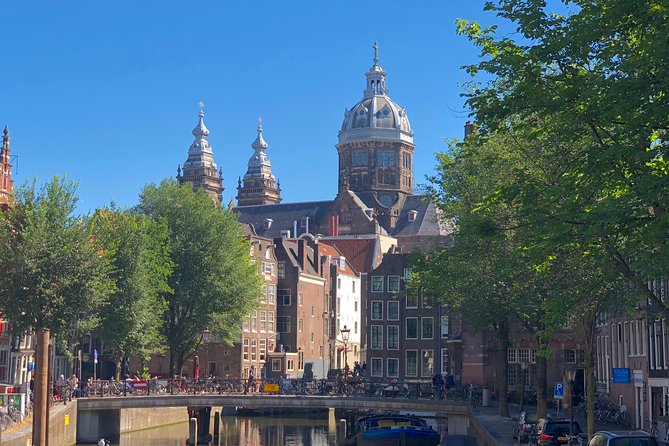
At Our Lord in the Attic Museum, the group discusses how Catholic worship continued after Catholicism became illegal in the 17th century. The key idea is that religion was sometimes tolerated under strict and unusual conditions.
You do not enter the hidden church on this walk. You see the building from outside, and the guide uses pictures of the interior to explain what lies above the ordinary-looking canal house. Admission is not included, though there is no charge for the outdoor stop itself.
This is a valuable distinction when planning your Amsterdam days. If you want to see the interior, you will need to return separately and buy admission. On the walk, the emphasis is on the broader idea of tolerance and how it worked in practice, with links to the way societies handle difference today.
The stop is brief, around 15 minutes, but it gives religious history a physical address. That makes the subject easier to remember than a general lecture.
Same city, a completely different afternoon:
- Amsterdam Classic Saloon Boat Cruise with Drinks and Cheese
★ 5.0 · 31,825 reviews - Amsterdam Luxury Canal Cruise + Unlimited Drinks & Bites option
★ 5.0 · 30,518 reviews - Amsterdam: Heineken Experience Ticket
★ 4.6 · 30,055 reviews - Amsterdam: Rijksmuseum Entry Ticket
★ 4.7 · 25,535 reviews
Chinatown and the origins of the coffeeshop policy
The Chinatown stop turns to Dutch drug policy. You hear how the area became a no-go zone in the 1970s and how that situation helped spark the development of coffeeshops dedicated to selling marijuana.
This section is useful because it explains a policy many visitors encounter without understanding. Amsterdam’s coffeeshops did not appear in a vacuum. Their rise connects to neighborhood problems, government choices, and an attempt to manage drug use through a particular set of rules.
The discussion lasts about 15 minutes and takes place outdoors. It is another example of the tour’s frank style. You are not just shown the famous parts of Amsterdam. You are given the political and social background behind them.
The Waag and Rembrandt’s first major breakthrough
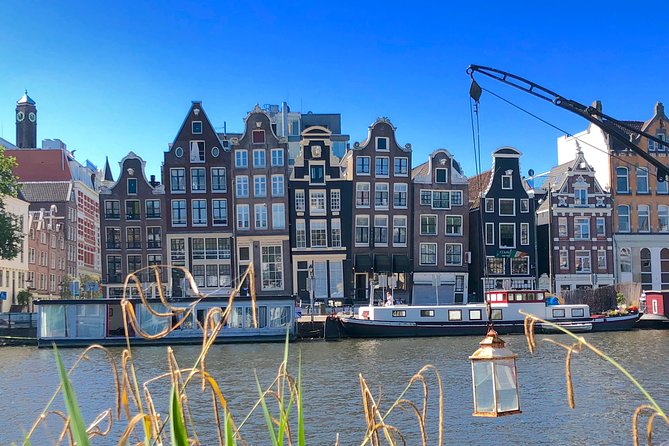
The Waag provides a change of tone. Here, the guide discusses the place where Rembrandt painted his first major work and explains how that painting changed portrait making.
A copy of the painting is used to point out details. That visual aid matters. Looking at a reproduction while standing near the site gives you something specific to study instead of asking you to remember a list of dates and names.
The stop lasts about 10 minutes. Admission is not included, so the experience remains an exterior explanation rather than a visit inside. Still, this is a good example of the tour’s method: take a familiar name, connect it to a real location, and show why the event mattered.
Oostindisch Huis and the price of the Golden Age
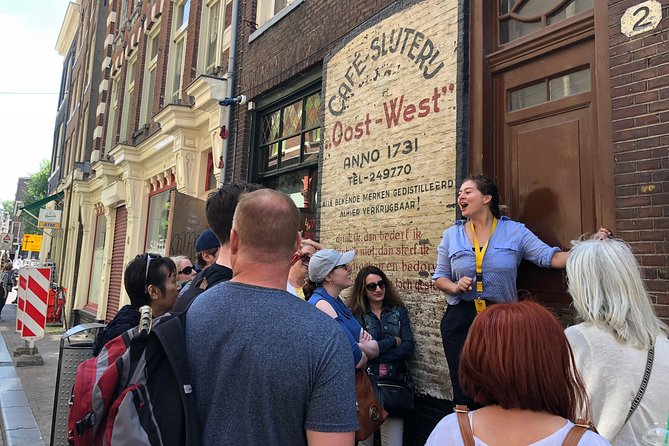
Oostindisch Huis is one of the most important stops for understanding Amsterdam’s 17th-century wealth. On weekdays, you can access a striking courtyard inside the building, though access depends on the day.
This was the headquarters of the Dutch East India Company, described here as the first and largest corporation in human history. The guide explains how Amsterdam became the center of a global trading empire and one of the richest cities on the planet during the period often called the Golden Age.
The tour does not present this wealth as a simple success story. It addresses the darker side of the trading system as well as its financial and political impact. That balance is important. You get a clearer picture of how modern capitalism developed, but also of the human cost behind commercial power.
Plan this stop with the weekday detail in mind. If you take the tour on another day, the courtyard may not be accessible. The outdoor discussion still has value, but the setting may be more limited.
Waterlooplein and Amsterdam’s Jewish Quarter
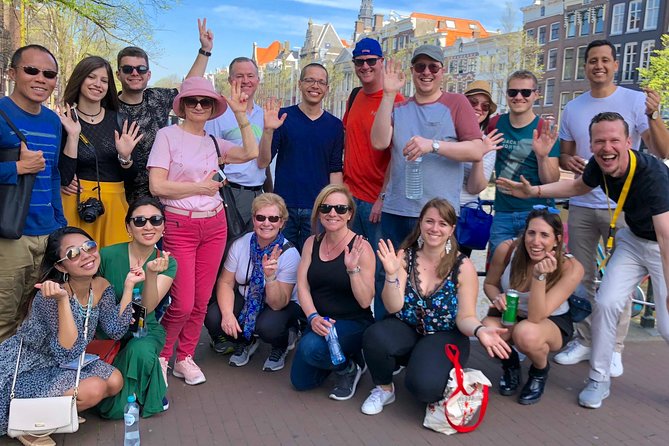
Waterlooplein Market is the oldest market in Amsterdam, set in what was once the Jewish Quarter. This stop deals with one of the city’s most painful subjects: the destruction of the neighborhood during the Second World War and the near destruction of its Jewish population.
The guide explains the effects of Nazi occupation and the hardship of the final winter of the war, including what Amsterdammers had to do to survive. The discussion also corrects a common misunderstanding about who was responsible for the devastation of the quarter.
This is not light sightseeing, and the 15-minute stop may feel compressed for such a serious subject. Still, placing the history at the market and neighborhood where it unfolded gives it weight. I would treat this as an introduction, then return later to a dedicated Jewish history museum or memorial if you want more time.
The Amstel and Amsterdam’s crooked houses
At the Amstel, or at another canal if the weather or guide makes that preferable, you learn why Amsterdam has canals and how the famous canal houses were built.
The guide covers several details you will notice again and again during your stay: why houses are so narrow, why some lean, why many have hooks near the roofline, and why Dutch residents are known for leaving curtains open. These are small observations, but they turn a walk through the center into a series of readable clues.
The canal-house stop lasts about 15 minutes. It is one of the lighter sections of the route and offers a welcome change after the war history at Waterlooplein.
A canal-side explanation also helps you understand the city’s appearance as more than a collection of attractive facades. The houses reflect transport needs, taxation, architecture, and the practical challenge of moving goods in a dense city.
Oudemanhuispoort and Amsterdam’s serious bicycle culture
Oudemanhuispoort is a former monastery that later became a hospital and is now part of the University of Amsterdam. It is also the setting for a discussion of Dutch bicycle culture.
You learn why Amsterdam has more bicycles than people and why so many bikes look plain, battered, or even unattractive. That is a useful lesson for first-time visitors. The bicycle is presented as an everyday tool, not as a polished accessory.
The stop takes about 10 minutes. You will also need to stay alert while walking through Amsterdam. One guide specifically noted the challenge of dodging bicycles, and that is practical advice rather than a complaint. Bikes have priority in many parts of the city, and visitors who stop suddenly in a cycle lane can create real trouble.
The Royal Palace and the end at Dam Square
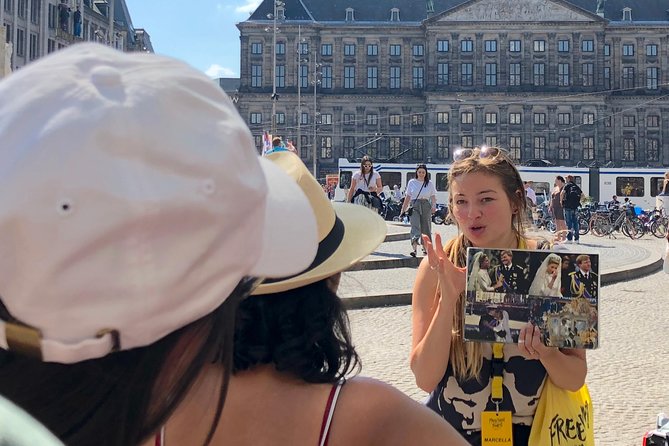
The final major stop is the Royal Palace Amsterdam on Dam Square. Here, the guide explains how the Netherlands changed from a republic into a monarchy and introduces the current royal family with pictures and some lighter royal gossip.
The palace itself is not included as an interior visit. The discussion takes place around the square, and the tour ends there according to the route description. The meeting information also describes the activity as ending back at the meeting point, so check your confirmation for the exact end instructions.
Ending at Dam Square works well. By this point, you have seen the commercial, religious, artistic, wartime, and royal sides of the old center. You can then decide which places deserve a longer return visit.
What the $5.93 price really gives you
At $5.93 per person, this is an unusually inexpensive introduction to central Amsterdam. The price should be understood as a low entry cost for a tip-based walk, not as the full value of a private sightseeing service.
You do not pay for most admissions, because the route is mainly outdoors. The hidden church, the Waag, and the Royal Palace are discussed from outside, and entrance costs are not included. The Oostindisch Huis courtyard is accessible only during weekdays, so timing can affect what you see.
The value comes from the guide’s interpretation, route planning, visual aids, and practical orientation. Guides named in the information include Gianni, Jaap, Carl, Esi, Sergio, David, Raymond, Fernando, Dani, Ramses, Alex, Sebastien, Alexander, Roman, and Samuel. Their styles will vary, but the strongest pattern is clear: expect humor, personal observations, local context, and advice about what to do next.
The 4.9 rating from 3,629 ratings and 98 percent recommendation rate suggest very strong satisfaction. Still, your experience will depend on the assigned guide, weather, group energy, and street crowds. The maximum group size of 15 is a helpful limit, but this is not a private tour.
Who should book this Amsterdam walk
I would choose this tour if you are visiting Amsterdam for the first time and want a fast sense of how the old center fits together. It also works for repeat visitors who want more context, especially around trade, religious tolerance, bicycles, and the city’s difficult wartime past.
It suits you if you enjoy history told with humor and do not mind direct discussion of prostitution and drug policy. It is also a good match if you want recommendations for the rest of your stay. Fernando, for example, is praised for suggesting places that visitors might not otherwise consider.
You may prefer another activity if you want extensive time inside museums, a quiet route away from crowds, or a tour focused on one subject. The format covers a great deal, but several stops last only 10 or 15 minutes. Think of it as a clear first map of Amsterdam, not the final word on any one landmark.
Free cancellation is available up to 24 hours before the start time. Changes or cancellations inside that window are not accepted for a refund, and the tour requires a minimum number of participants.
Should you book Absolutely Amsterdam?
Yes, if you want an affordable and lively first orientation to the old center. The route covers more than the standard postcard sights, and its best feature is the connection between ordinary street details and larger forces such as trade, war, religion, and public policy.
Book it early if your schedule is tight, since it is commonly reserved about 24 days ahead. Arrive ready to walk, listen around bicycles, and treat the stops as introductions. If the guide is as engaging as Raymond, Jaap, Sergio, or Fernando, you will leave with both a clearer map and a longer list of places to explore on your own.
FAQ
How long does Absolutely Amsterdam last?
The walking tour lasts approximately 2 hours and 30 minutes.
Where does the tour begin?
It begins at Freedam Tours, Beursplein 5, 1012 GZ Amsterdam, Netherlands.
Where does the tour end?
The route description says the tour ends at Dam Square. The additional meeting information says the activity ends back at the meeting point, so check your booking confirmation for the exact end instruction.
What language is the tour offered in?
The tour is offered in English.
Does the tour enter Our Lord in the Attic Museum?
No. The group sees the building from outside, and the guide uses pictures of the interior. Admission is not included.
Are entrance fees included?
Most stops are outdoor locations with no admission charge. Admission is not included for Our Lord in the Attic Museum, the Waag, or the Royal Palace.
How large is the group?
The tour has a maximum of 15 participants.
Newest Amsterdam write-ups
- Zaanse Schans: Half-Day Private Guided Tour★ 5.0 · 4 reviews
- Zaanse Schans: Private Cruise + Live Guide, Optional Drinks★ 4.7 · 26 reviews
- Zaanse Schans: Wooden Shoe Painting Workshop★ 4.9 · 23 reviews
- Amsterdam: Private Zaanse Schans Windmills and Volendam Trip★ 4.9 · 31 reviews
- Zaanse Schans: Pancake Restaurant Visit★ 4.5 · 26 reviews
- Amsterdam: Zaanse Schans E-Bike Tour with Windmills & Cheese★ 4.5 · 12 reviews
- Zaandam: Paint a Perfect Portrait workshop★ 5.0 · 5 reviews
- Volendam: Stroopwafel Experience with Tasting★ 3.6 · 93 reviews
Amsterdam Walking Tours, compared.

Anne Frank’s Story – Guided Walking Tour through Amsterdam
Read our review →
Life of Anne Frank and World War II Walking Tour
Read our review →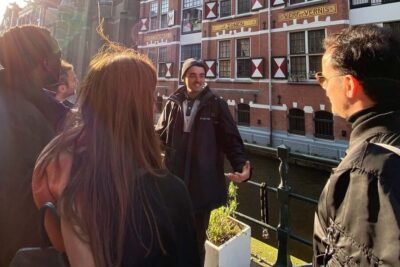

Anne Frank Walking Tour – Guided in EN/DE/IT/ES
Read our review →

Anne Frank Walking Tour Amsterdam Including Jewish Cultural Quarter
Read our review →
Amsterdam Highlights Walking Tour: Small Group Experience
Read our review →Browse the lists this tour appears in