
Reviewed · AMSTERDAM WALKING TOURS
Walking Tour about Golden Age Architecture, private local guide
Amsterdam’s Golden Age is written into the city’s canal houses, but you can walk past the best clues without noticing them. This private tour with local guide Anna teaches you how to read those façades, from hoisting beams and gables to the small stones that reveal an owner’s trade.
I like the personal format and the clever route from Dam Square through the canal belt to Westerkerk. I also like that the tour explains engineering, social class, and building use, not just dates and styles. The main consideration is pace: you’ll walk and stand for about 90 minutes, and the tour is not recommended if you use a walker or have difficulty walking.
Key points to know before booking
- Look above the shopfronts: Amsterdam’s façades reveal old trades, wealth, and building methods through gables, windows, hooks, and decorative stones.
- A private walk with Anna: Your group has the guide’s full attention, making it easy to ask questions, stop for photographs, and request extra detail.
- The route links major sights: You’ll move from Dam Square and the Royal Palace toward Huis Bartolotti, the Jordaan, and Westerkerk.
- Engineering is part of the story: The Royal Palace offers a lesson in building a grand structure on soft clay and marshy ground.
- The final stop is well placed: The tour ends beside Westerkerk, close to the Anne Frank House and the Prinsengracht.
- Plan for a standing tour: The walk lasts about 1 hour 30 minutes, with no mobility aids provided.
Why this architecture walk is different
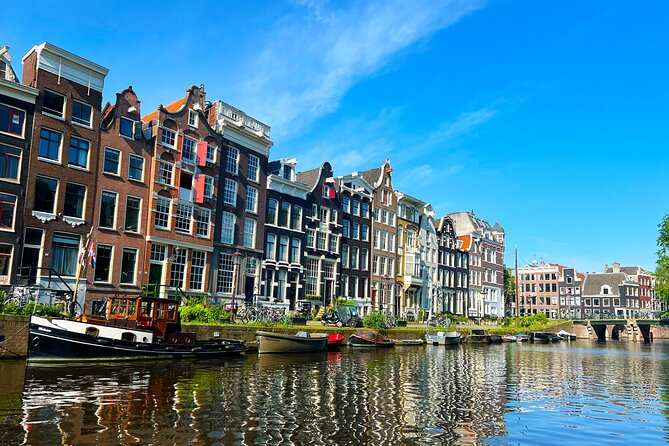
Most first walks through Amsterdam focus on canals, narrow houses, and photo stops. This one asks you to look harder. You’ll learn why buildings lean, how merchants used rooftop beams, and what small facade stones tell you about the people who lived and worked behind the brick.
That focus gives the tour a useful purpose. After 90 minutes, you should be able to look at a canal house and make a fair guess about its age, status, function, or original owner. You are not simply collecting sights. You are learning a visual code.
The private setup matters here. Architecture questions often come in quick bursts: Why is this house so narrow? Why do the windows look different next door? Why does the building tilt? With only your group present, you can stop Anna and ask. The available feedback repeatedly praises her friendly manner, clear English, patience with questions, and willingness to allow photo stops.
This is also a good choice if you have already seen Amsterdam’s main attractions and want a more focused second look. The tour does not enter paid sights, so its value rests in the guide’s explanations and the route itself. At $73.59 per person, it is not the cheapest way to walk around central Amsterdam. For a private group that wants a specialist explanation rather than a large general tour, the price can make sense.
More walking tours in Amsterdam:
- Anne Frank’s Story – Guided Walking Tour through Amsterdam
★ 5.0 · 11,619 reviews - Amsterdam: Life of Anne Frank and World War II Walking Tour
★ 4.8 · 10,467 reviews - Absolutely Amsterdam – the Essential Introductory Walking Tour
★ 5.0 · 3,629 reviews
Dam Square and the making of a trading city
The tour begins with Amsterdam’s rise during the 17th century. Dam Square gives Anna room to explain how the city became a major global trading center and how that success shaped the streets and buildings around you.
The opening is brief, about five minutes, but it gives the rest of the walk a framework. Amsterdam’s Golden Age was not just a period of artistic achievement. It was also a time of shipping, commerce, urban growth, and practical building decisions. The houses you see later make more sense once you understand who paid for them and what work they supported.
One practical point needs attention: the stated meeting point is the Royal Palace Amsterdam at Nieuwezijds Voorburgwal 147, while Dam Square is listed as the first stop. Since the palace faces Dam Square, this should be easy to sort out, but confirm the exact meeting spot when you book.
The Royal Palace and Amsterdam’s soft ground
The Royal Palace is an especially useful stop because it began as Amsterdam’s town hall during the Golden Age. It was designed to express the city’s power and prosperity, then later became a royal residence.
Anna explains its Dutch Neoclassical style, its materials, and the methods used to build such a large structure on difficult clay and marshy ground. That engineering story gives the building weight beyond its formal façade. Amsterdam’s monumental buildings were not simply placed on solid earth. They required planning and structural skill to remain stable in challenging conditions.
You spend about ten minutes here. The palace is discussed from the outside, with no admission included. That is worth knowing if you want an interior visit. This experience is about the building’s place in the city and the ideas behind its construction, not a palace tour.
Huis Bartolotti and the architecture of status
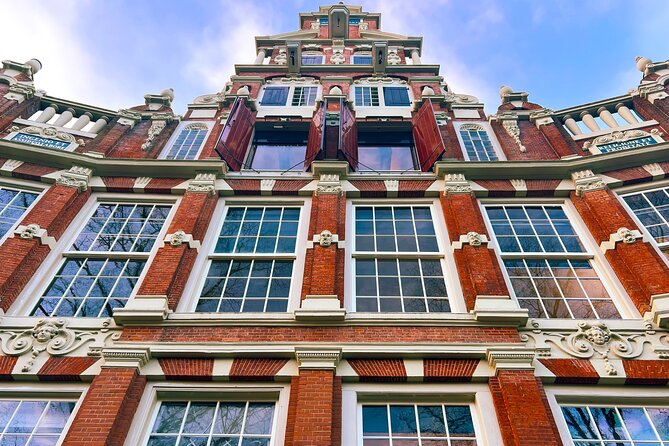
At Huis Bartolotti, the focus shifts from public power to private wealth. This 17th-century canal house is known for its red brick façade, large windows, and sandstone decoration.
The building’s design reflects the position of its original owner and his trading links with Italy. That detail helps explain why Amsterdam’s canal houses do not all look alike. Wealthy merchants used their homes to signal success, but they did so within local building traditions.
You get only about five minutes here, so do not expect a long architectural lecture at one address. The value comes from comparing this façade with the other houses along the route. Anna’s role is to point out the features you might miss on your own, especially the contrast between brick surfaces and carved stone details.
Same city, a completely different afternoon:
- Amsterdam Classic Saloon Boat Cruise with Drinks and Cheese
★ 5.0 · 31,825 reviews - Amsterdam Luxury Canal Cruise + Unlimited Drinks & Bites option
★ 5.0 · 30,518 reviews - Amsterdam: Heineken Experience Ticket
★ 4.6 · 30,055 reviews - Amsterdam: Rijksmuseum Entry Ticket
★ 4.7 · 25,535 reviews
Torensluis and Amsterdam’s crooked houses
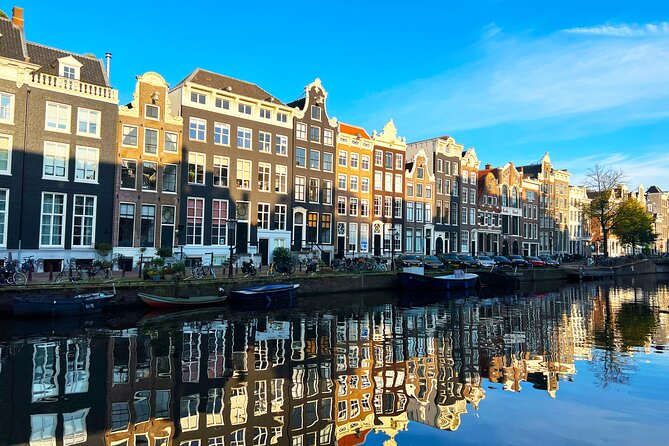
Torensluis is one of the strongest viewing points on the walk. From this broad bridge, you can compare four façade designs associated with Amsterdam’s mercantile class during the Golden Age.
The stop also introduces the Dutch version of Baroque design. Here, the style is not simply a list of curves and decoration. You see how dramatic details were adapted to narrow urban buildings and local materials.
Look closely at the crooked houses. Many buildings lean in distinctive ways because of Amsterdam’s soft ground and the long history of construction in the city. Some tilts are structural problems, while others may reflect the shape or movement of the building over time. The tour uses these houses to show both the limits of the site and the ingenuity of the people who built on it.
Torensluis lasts about ten minutes, enough time to compare several façades and take pictures. It is also a good place to ask Anna about how Amsterdam’s houses changed as the city grew.
De Dolphijn and the story behind a house name
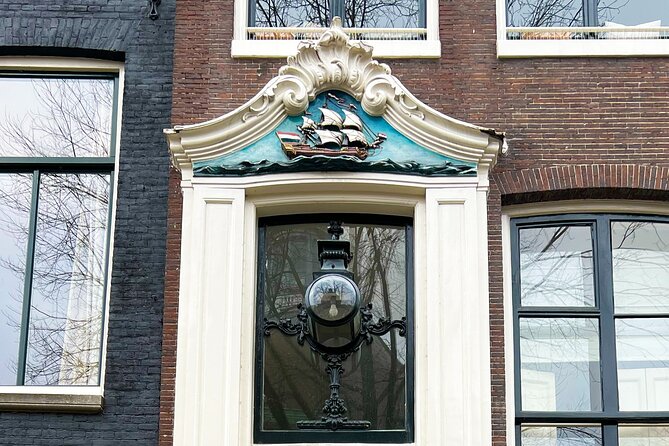
De Dolphijn connects architecture with a particular person and symbol. The dolphin motif referred to wealth and Amsterdam’s maritime trade. The house was once owned by Frans Banning Cocq, the captain portrayed in Rembrandt’s The Night Watch.
That personal connection makes this five-minute stop more memorable than a simple façade description. You see how a canal house could carry clues about status, trade, and its owner’s public identity.
The stop is short, so the emphasis is on interpretation rather than a full visit. If you enjoy linking art, architecture, and individual lives, this is one of the route’s more appealing details.
Ronde Lutherse Kerk and the power of the dome
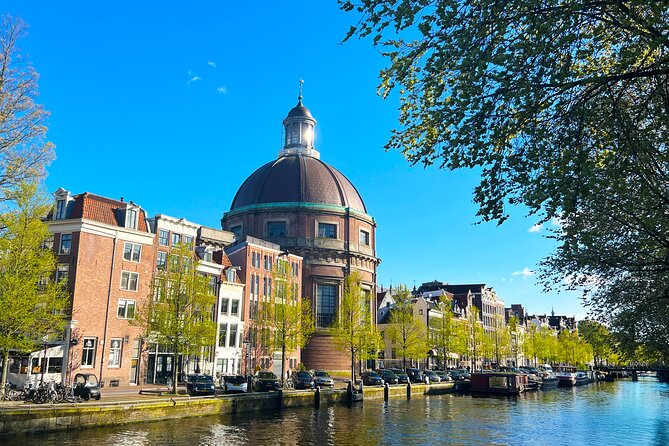
The Ronde Lutherse Kerk provides a change of shape and scale. Its dome represents the height of architectural ambition in the Renaissance period, giving you a useful contrast with the narrow merchant houses along the canals.
The stop lasts about five minutes. It is less about a long church visit and more about recognizing how a large rounded roof and formal religious building fit into Amsterdam’s city center.
Because most of the walk centers on façades and streetscapes, this brief look at a domed church helps break up the sequence. It also shows that Golden Age Amsterdam was not built in one single style or for one single social group.
Prinsengracht warehouses and practical design
Along Prinsengracht, the tour turns to warehouses and trade. These buildings were designed to work. Tall gables, large windows, and wooden hoisting beams helped merchants move heavy cargo between boats, street level, and upper floors.
The beams are easy to miss if you are looking only at the canals. Once Anna points them out, you begin to see how the buildings functioned. The clean exteriors and limited decoration were not a lack of ambition. They reflected a practical purpose, while the scale of the buildings showed the money behind Amsterdam’s commerce.
This stop lasts about five minutes, but it gives you one of the clearest explanations of how architecture supported daily business. I especially like this kind of detail because it connects the attractive canal view with the hard work that made the city prosperous.
The Jordaan and the clues in facade stones
The Jordaan receives the longest stop, about 20 minutes, and it is where the tour becomes most street-level and personal. In the 17th century, this area mixed homes, workshops, and small businesses. Craftsmen and laborers lived alongside commercial activity, producing a different feel from the grander canal districts.
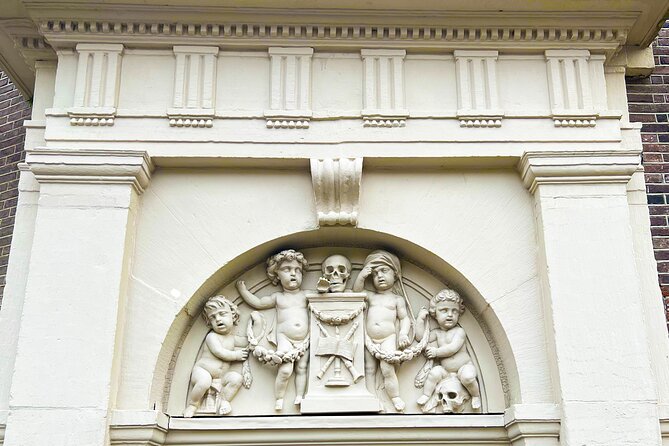
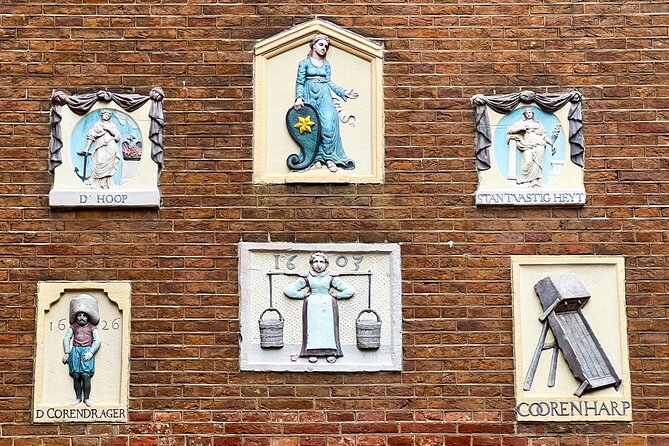
The main feature here is the gevelsteen, or facade stone. These small carved plaques were placed into building fronts to show a profession, identify a business, explain the building’s use, or mark something important about the residents.
They are easy to walk past. Some show tools, animals, ships, or other symbols connected to work and identity. Together, they turn the Jordaan’s façades into small public records. You get a sense of how people communicated before modern signs and street directories.
This is where a private guide is particularly useful. You can ask Anna to slow down, explain a carving, or point out another example nearby. The longer stop also gives you more time for photographs and for comparing the Jordaan’s tighter, more mixed-use streets with the grander houses seen earlier.
Westerkerk and a fitting finish
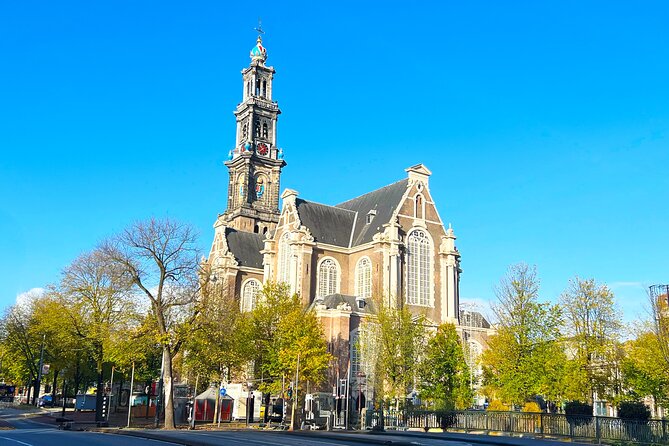
The final stop is Westerkerk, the tall Calvinist church beside the Anne Frank House. Its simple, airy design reflects Calvinist worship, while its 85-meter spire gives the Jordaan a powerful vertical marker.
The tower was completed in 1638 and is topped with the imperial crown, a symbol linked with Amsterdam’s status. Its clock chimes have marked the hours for centuries. Anne Frank wrote about those chimes in her diary, adding a later and deeply personal layer to the church’s story.
Westerkerk is also associated with Rembrandt, who was buried there. The tour ends at Prinsengracht 279, close to the Anne Frank House. That location is useful if you are continuing with nearby sightseeing, though an Anne Frank House ticket is not part of this experience.
The church stop lasts about five minutes. As with the Royal Palace, this is an exterior-focused discussion rather than an included interior admission. The ending works well because it brings together religion, art, civic identity, and the lived experience of the Jordaan.
Price, pace, and who gets the most from it
The price is $73.59 per person, with group discounts available. For one person or a large group, that may feel high for a 90-minute walk with no entry tickets. For a small private group, the calculation is different. You are paying for Anna’s attention, local context, and the ability to shape the conversation around your interests.
The tour is offered in English and uses a mobile ticket. Confirmation arrives at booking, and it is commonly reserved well ahead of the date, with an average booking lead time of 43 days. That does not guarantee it will sell out, but it is sensible to reserve early if Anna’s personal guiding style is the main reason you want this tour.
You should be comfortable walking and standing for the full 1.5 hours. The route is near public transportation, and service animals are allowed. Mobility aids are not provided, and the experience is not recommended for people who use a walker or have trouble walking and standing.
Bring water if you need it, since bottled water is not included. Wear shoes suited to city streets, and leave room in your schedule for photographs. The guide is happy to answer questions, which can stretch a short stop if your group gets interested.
Should you book this Amsterdam architecture tour?
Book it if you want to understand what you are seeing, not just photograph it. The strongest parts are the engineering explanation at the Royal Palace, the comparison of façades at Torensluis, the working details along Prinsengracht, and the facade stones in the Jordaan.
I would especially recommend it to architecture fans, repeat visitors, and curious first-time visitors who prefer a personal guide to a large group. Anna’s local connection, clear English, patience, and ability to explain social history alongside design are central to the experience.
Skip it if you want palace or church interiors, a relaxed sightseeing ride, or a tour with little walking. At $73.59, it earns its price through the guide’s insight rather than included admissions. For the right audience, it turns Amsterdam’s famous canal belt into something you can actually read.
FAQ
Where does the tour start?
The stated meeting point is the Royal Palace Amsterdam, Nieuwezijds Voorburgwal 147, 1012 RJ Amsterdam. Dam Square is listed as the first stop, so confirm the precise meeting location when booking.
Where does the tour end?
The tour ends at Westerkerk, Prinsengracht 279, 1016 DL Amsterdam, near the Anne Frank House.
How long does the walking tour last?
The tour lasts approximately 1 hour 30 minutes.
Is this a private tour?
Yes. Only your group participates, and a private guide is included.
What language is offered?
The tour is offered in English.
Is the tour suitable for people with limited mobility?
It is not recommended for participants who use a walker or have trouble walking and standing for 1.5 hours. Mobility aids are not available. Service animals are allowed.
Newest Amsterdam write-ups
- 5dporn experience: adres Oudekerksplein 18 Amsterdam★ 3.0 · 13 reviews
- Amsterdam private city walking experience with a local★ 5.0 · 12 reviews
- 3-course Dinner in the Dark Amsterdam★ 4.5 · 40 reviews
- Laser Tag in Amsterdam– The Ultimate Action-Packed Experience!★ 5.0 · 7 reviews
- 2.5 hours Amsterdam Pedicab Tour★ 5.0 · 7 reviews
- 2 Hours Private Amsterdam Rickshaw Tour★ 5.0 · 16 reviews
- Free Roam VR in Amsterdam – Immerse Yourself in a Virtual World!★ 5.0 · 5 reviews
- E-Bike Tour, Amsterdam’s Highlights and Hidden Gems★ 5.0 · 94 reviews
Amsterdam Walking Tours, compared.

Anne Frank’s Story – Guided Walking Tour through Amsterdam
Read our review →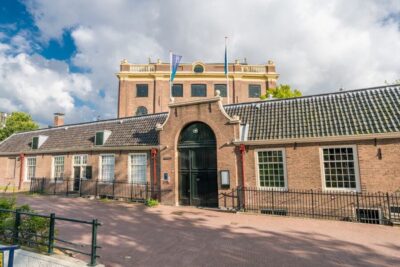
Life of Anne Frank and World War II Walking Tour
Read our review →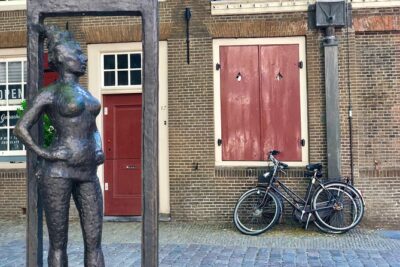
Absolutely Amsterdam – the Essential Introductory Walking Tour
Read our review →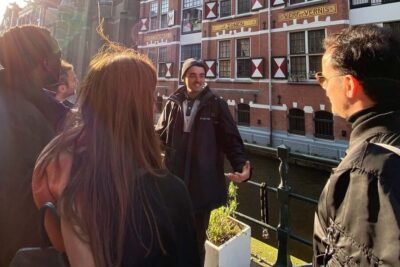

Anne Frank Walking Tour – Guided in EN/DE/IT/ES
Read our review →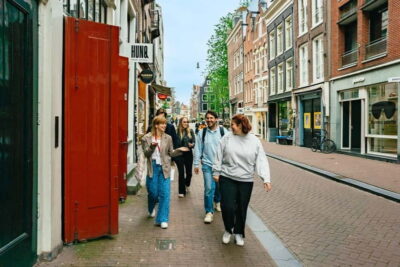

Anne Frank Walking Tour Amsterdam Including Jewish Cultural Quarter
Read our review →Browse the lists this tour appears in