
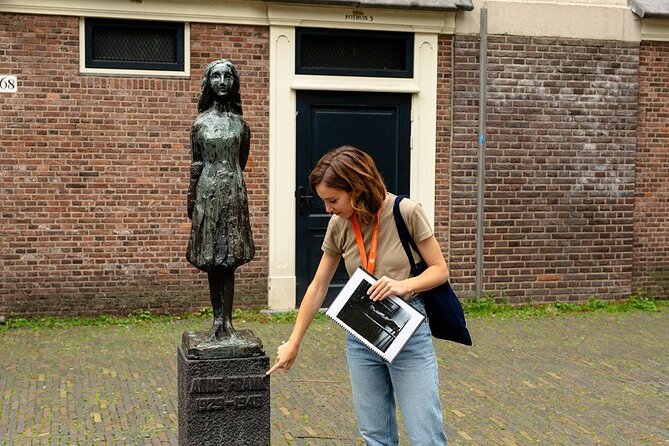
Reviewed · ANNE FRANK WALKING TOURS
Anne Frank Walking Tour in Amsterdam
Amsterdam’s Anne Frank story becomes far more powerful when you see it in the streets around the hiding place. This two-hour walk connects Jewish Amsterdam with wartime resistance, deportation, hunger, and survival, ending near the Anne Frank House rather than treating Anne’s story as an isolated museum visit.
I like the low-cost group format, priced at $55.94 per person, and the way the route puts Anne Frank into a wider story about occupied Amsterdam. I also like the focus on the February Strike, the Winter of Hunger, and the Hollandsche Schouwburg. The main drawback is the group size, which can reach 45 people, and admission to the Anne Frank House is not included.
Key points to know before booking
- The walk covers more than Anne Frank: You’ll connect her story with Amsterdam’s Jewish Quarter, resistance efforts, deportation, and wartime hardship.
- The Portuguese Synagogue and Jewish Museum area add context: These landmarks help explain the long-standing Jewish presence in Amsterdam.
- The Hollandsche Schouwburg is a serious, emotional stop: The former theater became a deportation center and now serves as a memorial and museum.
- You do not enter the Anne Frank House: The tour finishes near it, while house tickets must be bought separately from the official website.
- The group may include up to 45 people: This keeps the price lower, but it may feel less personal than a private walk.
- Book early and choose your time carefully: The tour is often booked about 34 days ahead, with several departure times during the day.
What this Anne Frank walk helps you understand
Anne Frank’s diary is familiar to millions of readers. It is easy, though, to picture her story as something that happened only inside the Secret Annex. This walk helps correct that narrow view.
You’ll see how the wider city shaped the lives of Jewish residents during the German occupation. The guide discusses how people coped, where families hid, how resistance took shape, and how deportation affected Amsterdam. That broader setting gives the Anne Frank House more meaning if you visit it separately.
The experience is offered in English and lasts about two hours. It is a walking tour, so you should expect a steady route through central Amsterdam rather than a museum visit with long indoor stops. Admission to the listed walking sites is free, but entry to the Anne Frank House is not part of the package.
I see this as a useful first step for anyone who wants historical context before visiting the Anne Frank House. It also works for visitors who cannot get house tickets, since the walk still takes you through places tied directly to the Jewish community and the occupation.
More Anne Frank walking tours:
- Anne Frank’s Story – Guided Walking Tour through Amsterdam
★ 5.0 · 11,619 reviews - Amsterdam: Life of Anne Frank and World War II Walking Tour
★ 4.8 · 10,467 reviews - Amsterdam: Anne Frank Guided Small Group Walking Tour
★ 4.8 · 2,722 reviews
Starting at Nieuwe Amstelstraat
The meeting point is Nieuwe Amstelstraat 1, 1011 RH Amsterdam. It is near public transportation, which makes the tour practical to fit into a day of sightseeing.
You’ll want to arrive ready to walk. The tour is not built around food, shopping, or free time. Its purpose is to connect landmarks and stories, so comfortable shoes and attention to the guide matter more than packing a full day bag.
The schedule offers several departure times. That flexibility is helpful if you want to visit a museum in the morning, take a canal cruise later, or arrange a separate Anne Frank House visit around the walking tour. Still, you should book the walk well ahead. It is booked about 34 days in advance on average, a useful warning if your Amsterdam dates are fixed.
The activity details say it ends back at the meeting point, while the route description says the tour concludes near the Anne Frank House. Since those details do not perfectly match, check the exact return arrangements when you book. Either way, the route is centered on central Amsterdam and public transportation is nearby.
Walking through Amsterdam’s wartime streets
The first hour focuses on Amsterdam itself, especially places that still carry traces of the war. The guide explains how citizens lived under occupation and how the city responded to pressure, fear, and persecution.
This is where the tour gains its footing. You are not simply shown a plaque and handed a date. The guide’s job is to connect buildings and monuments with the choices people faced during the occupation. Some helped. Some resisted. Some hid. Some were forced into impossible decisions.
The supplied feedback points to a guide who was well prepared and clear, with the history presented in an enjoyable and organized way. That matters on a subject this heavy. A strong guide can explain difficult events without turning the walk into a flood of names and dates.
The route is also a good reminder that war history is not confined to battlefields. In Amsterdam, occupation affected homes, theaters, synagogues, neighborhoods, and ordinary streets. You’ll hear how citizens coped while the city’s Jewish population faced increasing restrictions and danger.
I would not expect every building to offer a dramatic visual clue. Much of the value comes from the explanation attached to each place. Keep your attention on the stories, not just on what appears in front of you.
The Jewish Quarter, Portuguese Synagogue, and Jewish Museum area
The Jewish neighborhood gives the tour its strongest sense of place. The area includes the Portuguese Synagogue and the Jewish Museum, both important landmarks for understanding Amsterdam’s Jewish community.
The Portuguese Synagogue helps show that Jewish life in Amsterdam did not begin with the Second World War. The neighborhood had its own institutions, traditions, and social world long before the occupation. That context keeps the tour from reducing Jewish Amsterdam to a story of persecution alone.
The Jewish Museum area adds another layer. You’ll learn why this part of the city mattered during the war and how the occupation changed daily life. The guide’s explanation is especially useful here because the meaning of a neighborhood is not always obvious from the street.
Admission to this portion of the walking route is listed as free. You should not assume that this means you will receive a full museum visit inside every building. The tour is primarily an outdoor walk, and the museum and synagogue are discussed as significant places along the route.
For me, this is one of the best reasons to book the tour even if Anne Frank is your main interest. You get a broader view of the people and community behind the familiar diary. That makes the later discussion of hiding and deportation feel less abstract.
More walking tours in Amsterdam:
- Absolutely Amsterdam – the Essential Introductory Walking Tour
★ 5.0 · 3,629 reviews - Amsterdam: Anne Frank Walking Tour – Guided in EN/DE/IT/ES
★ 4.9 · 2,676 reviews - Amsterdam: Guided Cultural Walking Tour
★ 4.9 · 2,384 reviews - Amsterdam: Guided Ganja Walking Tour of Coffee Shops
★ 4.2 · 2,092 reviews
The February Strike and Dutch resistance
The tour also covers Dutch resistance efforts, including the February Strike. This part of the walk shows that Amsterdam’s wartime story included organized opposition as well as fear and compliance.
The February Strike is important because it brings public resistance into the narrative. You’ll hear how people responded to the persecution of Jewish residents rather than seeing the occupation only through the experience of those in hiding.
The guide also discusses secret locations where families hid, including the Franks. The details help you understand that hiding was not a simple matter of closing a door and waiting. It depended on concealed spaces, trusted helpers, supplies, silence, and an enormous amount of risk.
The tour does not take you inside the Secret Annex. That distinction is important. You are learning about the setting and the people around it, not replacing the Anne Frank House experience.
This section will suit you if you want history explained through human choices. It may be less satisfying if you prefer a tour packed with accessible interiors or hands-on exhibits. The route is about interpretation and location, with the guide doing much of the work.
The Winter of Hunger and life under occupation
The Winter of Hunger brings the discussion down to the hardship faced by the wider Dutch population. It reminds you that the occupation affected daily survival across the country, though Jewish residents faced systematic persecution and deportation.
Including this subject makes the tour feel more complete. Anne Frank’s story is heartbreaking, but it happened within a society facing shortages, fear, forced decisions, and unequal suffering. The Winter of Hunger shows how food and basic survival became central parts of wartime life.
A good walking tour should help you place a personal story inside its larger setting, and this is where that happens. You’ll move from the experience of a hidden family to the pressures felt throughout Amsterdam.
The subject matter is serious, so this may not be the right pick if you want a light introduction to the city. For a visitor seeking a thoughtful historical walk, though, the difficult material is part of the value.
Hollandsche Schouwburg, from theater to deportation center
Hollandsche Schouwburg is among the most significant stops. This former theater was turned into a deportation center for Jews during the occupation. It now serves as a memorial and museum.
The change in purpose tells a stark story by itself. A place designed for performances became part of the machinery used to gather and deport people. The tour explains that transformation and places it within the wider story of Amsterdam’s Jewish population.
This stop gives the route a physical point where persecution becomes especially concrete. You are not only hearing about deportation in general terms. You are standing at a site tied to the process.
The tour information does not promise a separate entrance to the museum, so plan on the guide presenting the site as part of the walking route. If you want more time inside, you may need to arrange that separately.
I would expect this to be one of the more somber moments of the walk. It is not a quick photo stop. Give yourself room afterward if you need a quiet break before continuing with the day.
Finishing near the Anne Frank House
The final part brings the story toward the Anne Frank House. Here, the guide discusses Anne’s life and legacy and points you toward the place most closely associated with her diary.
The tour does not include entrance to the house. Tickets begin at €7 according to the supplied tour details, and you must buy them separately through the official Anne Frank House website. Do not treat the walking tour as a substitute for house admission.
If you secure a separate ticket, the walk can work well as preparation. You’ll arrive with a better understanding of the neighborhood, the occupation, and the people who helped families hide. The museum visit can then focus more clearly on the rooms, documents, and personal story inside.
If you cannot obtain a house ticket, the tour still offers a substantial historical route. You will not see the Secret Annex interior, but you will learn about Anne’s life and legacy while standing near the building connected with her story.
Because the walking tour and house visit are separate products, leave enough time between them. The tour lasts about two hours, but a group walk can run at a different pace than your own schedule. Check the stated meeting and ending arrangements before booking a same-day connection.
Is $55.94 a fair price?
At $55.94 per person, this is not the cheapest way to walk through Amsterdam. It is also not priced like a private guide. The group format helps keep the cost down, and the fee includes a professional English-speaking guide.
The value rests mainly in the explanation. Most of the route can be experienced from public streets and free-access locations, so you are paying for structure, historical context, and the ability to connect places that might otherwise seem unrelated.
I think the price makes sense if you want a focused introduction to wartime Amsterdam and would rather have the story organized for you. It is less compelling if you are comfortable researching the route yourself or want a small, highly personal tour.
The maximum group size is 45 people. That is a fairly large group for a walking tour. You may have trouble hearing every word if the street is noisy or if you fall behind, and personal questions may be harder to manage. In return, the larger format helps hold down the per-person cost.
The rating is 4.9 from 15 reviews, with 93 percent of customers recommending the experience. That is encouraging, especially since the praise focuses on clear preparation and fascinating history, but the sample is small. I would treat it as a positive sign, not a guarantee of a perfect outing.
Who should book this experience?
I would point this tour toward:
- First-time visitors who want a clear introduction to Amsterdam’s wartime history
- Readers of Anne Frank’s diary who want to understand the city around the Secret Annex
- Adults and older children who can handle serious subjects about persecution and deportation
- Visitors who want a guided group walk at a lower price than a private tour
- Anyone planning to visit the Anne Frank House separately
- People with flexible schedules who can choose among several tour times
I would think twice if you strongly dislike large groups or need a very quiet, personalized experience. You should also reconsider if your main goal is to enter the Anne Frank House, since the walking tour does not provide admission.
The subject is emotionally difficult. That is not a flaw, but you should plan the rest of your day with some flexibility rather than rushing straight to another attraction.
Practical booking advice
Book ahead, especially if you are visiting during a busy period or need a particular departure time. The average booking lead time of about 34 days suggests that waiting until the last minute may not work well.
Use the official Anne Frank House website for separate admission. The walking tour does not include that ticket, and buying the two experiences separately means you must coordinate the times yourself.
The tour is offered in English only. Make sure that works for everyone in your group before paying, since the value depends heavily on following the guide’s explanations.
Service animals are allowed, and most people can participate. The activity is near public transportation, which helps with arrival and departure. Tips, food, and drinks are not included, so budget for those separately if needed.
The cancellation policy is strict: the experience is non-refundable and cannot be changed for any reason. Only book once your Amsterdam plans are firm.
Should you book the Anne Frank Walking Tour?
Book it if you want context before the Anne Frank House, a guided look at Amsterdam’s Jewish Quarter, and a serious discussion of resistance, deportation, and wartime survival. The strongest parts are the clear historical presentation, the Portuguese Synagogue and Jewish Museum area, the February Strike, and the Hollandsche Schouwburg.
Skip it if you want entry to the Anne Frank House itself, a private guide, or a small group with plenty of personal attention. For most visitors who value explanation over sightseeing alone, the $55.94 price is reasonable, provided you accept the group size and buy house tickets separately.
FAQ
Where does the Anne Frank Walking Tour start?
The tour starts at Nieuwe Amstelstraat 1, 1011 RH Amsterdam, Netherlands.
How long does the walking tour last?
The tour lasts approximately two hours.
What language is the tour offered in?
The tour is offered in English.
Is admission to the Anne Frank House included?
No. Admission to the Anne Frank House is not included. Separate tickets can be purchased through the official Anne Frank House website, with prices starting at €7 according to the tour details.
What places does the tour cover?
The route covers central Amsterdam, the historic Jewish neighborhood, the Portuguese Synagogue, the Jewish Museum area, wartime locations, secret hiding places, the Hollandsche Schouwburg, and the area near the Anne Frank House.
How large can the group be?
The tour can have a maximum of 45 participants.
Can I cancel or change my booking?
No. The experience is non-refundable and cannot be changed for any reason.
Newest Amsterdam write-ups
- Rotterdam, Delft and the Hague Day Trip from Amsterdam★ 4.5 · 55 reviews
- Bruges Day Trip from Amsterdam★ 4.5 · 14 reviews
- Bike rental Volendam – Explore the Countryside of Amsterdam★ 5.0 · 16 reviews
- Amsterdam Architecture Tour★ 5.0 · 4 reviews
- Amsterdam small-group canal cruise in 1920s saloon boat★ 5.0 · 13 reviews
- Amsterdam Canal Cruise with Live guide & Two drinks – Central St.★ 5.0 · 151 reviews
- Amsterdam Craft Beer Brewery Tour by Bus with Tastings★ 5.0 · 74 reviews
- Authentic Italian Dinner in Cozy Canal Home in Amsterdam★ 5.0 · 4 reviews
Anne Frank Walking Tours, compared.

Anne Frank’s Story – Guided Walking Tour through Amsterdam
Read our review →
Life of Anne Frank and World War II Walking Tour
Read our review →

Anne Frank Walking Tour – Guided in EN/DE/IT/ES
Read our review →
Anne Frank Walking Tour Amsterdam Including Jewish Cultural Quarter
Read our review →
Anne Frank’s Last Walk & See Anne Frank House in Virtual Reality
Read our review →
Anne Frank and Jewish Quarter Amsterdam Private Walking Tour
Read our review →
Browse the lists this tour appears in