

Reviewed · VAN GOGH MUSEUM TOURS
Amsterdam: Van Gogh Museum Guided Tour & Entry Ticket (Max 6 ppl)
Vincent van Gogh’s paintings are famous. His life is often reduced to a few dramatic facts. This 90-minute small-group tour gives you something better: a clear path through his changing art, family ties, mental struggles, and short career, with no more than six people around the guide.
I like the intimate group size, and I like that guides such as Cecile, Liz, Lucy, Mercedes, and Genevieve are praised for making the paintings easy to understand. The main drawback is the price, $168.09 per person, which is a lot for a 90-minute museum visit. You are paying for expert guidance and museum entry, not just admission.
Key points at a glance

- Maximum of six people: Small enough for questions, conversation, and a closer connection with the guide.
- A life told through paintings: Follow Vincent from his dark Brabant period through Paris and Arles.
- Dutch art historian guide: Guides including Lucien, Anke, Cecile, Liz, Lucy, Mercedes, and Genevieve have led especially well-regarded tours.
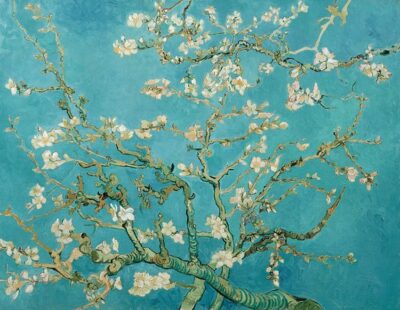
- Major works take center stage: Expect attention to The Potato Eaters, Sunflowers, The Yellow House, and Almond Blossom.
- Stay inside afterward: The guided portion ends at the Van Gogh Museum, but you can continue exploring on your own.
- Best for first-time visitors: The tour is built to help you find the important works quickly when your time is limited.
Why a small Van Gogh tour makes a difference
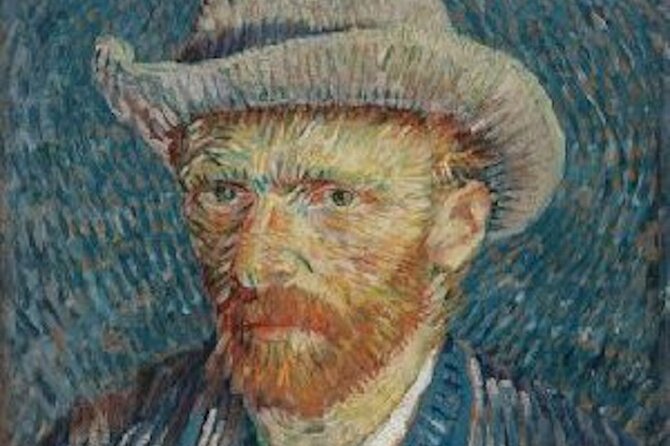
The Van Gogh Museum can feel like a lot to take in. You are not simply looking at a handful of famous canvases. You are following a career that changed quickly, from heavy, earth-toned scenes to bright, restless paintings filled with color and movement.
On your own, you may understand the broad outline: Vincent painted Sunflowers, struggled with mental illness, and died young. A strong guide adds the links between those facts. The family story, his dependence on his brother Theo, his relationships, his artistic experiments, and his emotional state all become part of the way you look at the paintings.
The six-person limit matters here. In a large museum group, you often hear a speech and move along. With a maximum of six, you can ask why a color matters, how one period differs from another, or what changed after Vincent moved to a new place. The small format also makes it easier to hear the guide in crowded galleries.
This is not a tour for every museum visitor. If you prefer to move slowly in silence, read every label, and choose your own route, a self-guided visit may suit you better. One piece of feedback points to a real concern: a guide can spend too much time talking in one spot, leaving less time for the art or for rooms on another floor. The quality of the experience depends heavily on the guide’s pacing.
More ways to see the Van Gogh Museum:
- Amsterdam: Van Gogh Museum Ticket and City Canal Cruise
★ 4.6 · 3,899 reviews - Amsterdam: Van Gogh Museum Ticket & Canal Cruise
★ 4.5 · 3,304 reviews - Van Gogh Museum Amsterdam Exclusive Tour w/ Reserved Entry
★ 5.0 · 1,760 reviews
Starting at Paulus Potterstraat 7
The meeting point is Paulus Potterstraat 7, in Amsterdam’s Museumplein area. The tour ends at the Van Gogh Museum, Museumplein 6. The short distance between the start and end matters because the guide can begin the story before you reach the first gallery, then carry it into the collection.
Bring your mobile ticket and arrive ready for a guided museum visit in English. Confirmation is provided when you book. The experience is near public transportation, and most people can take part. Service animals are allowed.
The museum assigns timed entry slots, and those times are released only three months ahead. If you book earlier than that, your chosen time is a preference rather than a guarantee. The provider tries to match it once the museum releases the schedule. If your day depends on a precise museum time, keep this point in mind before arranging other plans.
Vincent before the famous paintings
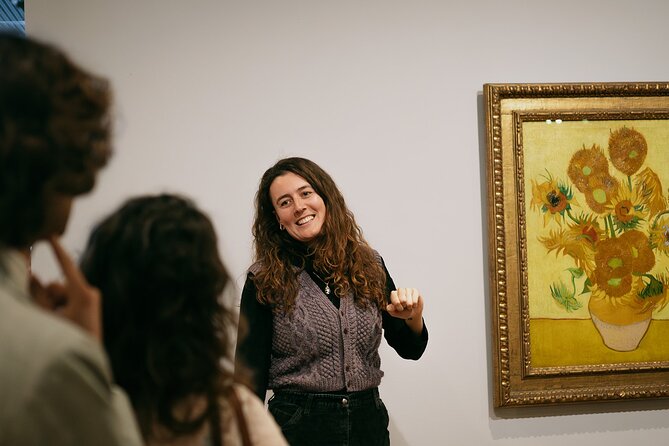
The tour begins with Vincent’s life, not just his best-known pictures. You learn why he took up painting at age 27 and how unusual that decision was. This gives the early works more weight. He was not a child prodigy moving naturally toward art. He came to painting later, with a difficult path ahead.
Theo, Vincent’s brother, is central to the story. Their relationship helps explain how Vincent kept working, where his support came from, and why the family story cannot be separated from the art. The guide also discusses Vincent’s relationships and family connections, giving you a less polished and more human view of the artist.
That background helps when you look at The Potato Eaters. It is not the bright Van Gogh many people expect. The work belongs to his dark period in Brabant, with rough figures and a somber palette. You can see an artist searching for a way to show ordinary life with force, even before he had found the brushwork and color that later made him famous.
A good guide will not treat this early period as a warm-up that you can skip. It shows where Vincent started. His later paintings become more interesting when you understand how far he moved from these dark rural scenes.
Paris, color, and a new way of seeing
The Paris period marks a sharp change. Vincent encountered new ideas and began experimenting with color, brushwork, and the work of other artists. The tour places this shift within his wider development instead of presenting it as a sudden miracle.
This is one of the useful reasons to visit with a guide. The museum’s paintings are arranged to show change over time, but you may not notice every connection while moving from room to room. A guide can point out how the palette grows lighter, how the brushwork becomes more active, and how Vincent’s approach becomes less tied to the heavy tones of Brabant.
You do not need a background in art to follow this part. The best guides explain technique in plain language and connect it to Vincent’s life without claiming that every painting is a direct diary entry. Lucien, Lucy, Liz, and Mercedes are praised for explaining the history, technique, and emotional side of the work in a clear way.
Still, pay attention to the pace. The museum contains more than the paintings named in the main tour outline. If your guide spends a long time on one canvas, you may pass over other rooms quickly. Ask questions early if there is a specific work or period you most want to see.
More museums and galleries in Amsterdam:
- Amsterdam: The Upside Down Museum Entrance Ticket
★ 4.4 · 9,506 reviews - Amsterdam: Red Light Secrets Museum Entry Ticket
★ 4.2 · 5,722 reviews - Amsterdam’s Weirdest Museum: Believe It or Not!
★ 4.5 · 4,086 reviews - Amsterdam: NEMO Science Museum Ticket
★ 4.4 · 2,979 reviews
Arles, Gauguin, and the yellow house
Vincent’s time in Arles is one of the tour’s strongest story sections. His relationship with Gauguin, the yellow house, and the increasingly unsettled direction of his life give the paintings a tense backdrop.
The Yellow House becomes more than a bright building on a canvas. It connects to Vincent’s hope for an artistic community and to the difficult months that followed. His relationship with Gauguin is presented alongside his artistic ambition and mental difficulties, rather than as a separate piece of gossip.
This part of the visit can be emotional, especially when the guide connects the paintings to the final stage of Vincent’s life. Anke is praised for telling the story with warmth and care, and one account describes the final paintings as deeply moving with her narration. That kind of delivery will appeal to you if you want the visit to feel personal as well as academic.
There is a risk here, too. Van Gogh’s mental health is important, but it should not become the only lens through which you view him. The tour aims to show his genius, temper, and mental struggles together. You should come away seeing a serious working artist, not only a tragic figure.
Sunflowers, Almond Blossom, and the major works
The famous paintings receive the attention you would expect. Sunflowers and Almond Blossom are not treated as isolated icons. Their color, purpose, and place in Vincent’s development help explain why they continue to hold so much attention.
Sunflowers can be easy to glance at and pass by because they are so familiar from posters and reproductions. In the museum, a guide can slow you down and help you look at the paint itself, the color choices, and the feeling created by repeated forms.
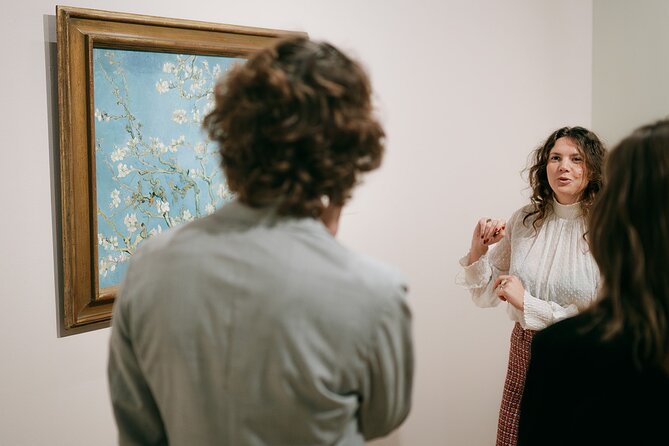
Almond Blossom brings another mood. The tour uses works such as this to show Vincent’s range and the way his subjects could carry personal meaning. You may find that seeing the original matters most when a guide first gives you a few things to look for, then lets you stand with the painting.
The tour is designed to focus on the museum’s key works, which suits a first visit or a tight Amsterdam schedule. It is not intended to replace a full day of looking at every room. That distinction is important. You get a guided route through the main story, then you may stay in the museum for as long as you wish after the tour.
The woman behind Vincent’s fame
The tour’s life story does not stop with Vincent’s death at 37 or Theo’s death a few months later. It also asks who helped make Vincent famous after both brothers were gone.
That question brings a valuable change in focus. The story is not only about the troubled artist at the easel. It is also about the people who preserved his work, told his story, and helped the public understand his importance. The guide uses this part of the story to show that artistic fame is shaped by family, persistence, and decisions made after an artist’s lifetime.
This is an especially useful point for anyone who already knows the standard Van Gogh tale. You may have heard about the ear, the asylum, and the final years many times. The later story adds a less predictable angle and reminds you that Vincent’s reputation did not simply appear by itself.
Guides who make or break the visit
The strongest part of this experience is the guide. Names praised for clear and engaging tours include Titia, Lucien, Anke, Cecile, Lucy, Liz, Mercedes, and Genevieve. The exact guide is not guaranteed, but the repeated strengths are worth noting: clear storytelling, strong art knowledge, patience with questions, warmth, and the ability to connect one period to another.
Cecile is described as personable, upbeat, and good at answering questions. Liz is praised for guiding a group through a crowded museum while finding the key paintings. Lucy is noted for giving a thorough overview without losing the human side of Vincent’s story.
A small group gives you a better chance to speak with the guide directly. That can turn a standard museum route into a conversation. It also helps if you are visiting with a child or a companion who needs context to stay interested. One account describes a young son remaining engaged and continuing to discuss the tour later in the day.
Do not expect every guide to use the same style. One may focus on the emotional story, another on technique, and another on family history. If you have a strong preference, you can ask questions during the tour rather than waiting for the end.
Is $168.09 a fair price?
At $168.09 per person, this is a premium museum visit. The price includes admission and the guided experience, but you should judge the value against your own interest in Van Gogh and your time in Amsterdam.
For a first visit, the price can make sense if you want someone to lead you through the collection and explain what you are seeing. You are paying for a small group, a specialist guide, and a focused route through one of Amsterdam’s busiest cultural attractions. The value is highest if you would otherwise feel lost, rushed, or unsure which paintings deserve your attention.
The value is weaker if you already know the collection well or prefer to spend several hours at your own pace. The guided portion lasts about 1 hour and 30 minutes, although one account describes a longer visit. You should plan around the stated 90-minute duration and treat any extra time with the guide as a bonus, not a promise.
The ability to stay afterward improves the deal. You can take the guided route first, then revisit paintings, explore other areas, or read the museum material without being hurried out when the tour ends.
Who should book this experience?
I would point this tour toward:
- First-time Van Gogh Museum visitors who want a clear route through the collection.
- Couples or families who prefer a small group to a large headset tour.
- Anyone short on time in Amsterdam but eager to see the major works.
- People who want life story, technique, and emotional context together.
- Museum visitors who enjoy asking questions and discussing what they see.
I would think twice if you want complete control over the route, dislike spoken explanation in galleries, or plan to spend most of the day reading labels and studying lesser-known works. The tour’s focus on highlights is useful, but it also means some rooms may receive less attention.
The free cancellation policy gives you flexibility: cancel at least 24 hours before the start time for a full refund. Changes or cancellations made later are not accepted for a refund, and cut-off times use Amsterdam’s local time.
Should you book the Van Gogh Museum tour?
Book it if you want the Van Gogh Museum to make sense as a story rather than a string of famous images. The small group, English-speaking Dutch art historian, and chance to remain inside afterward make this more useful than a quick guided march through the galleries.
I would not book it simply because Van Gogh is popular. Book it because you want help seeing how The Potato Eaters, Sunflowers, The Yellow House, and Almond Blossom belong to different moments in one short, difficult career. If the price fits your budget, this is a strong choice for a first visit, especially when your Amsterdam schedule is tight.
FAQ
How long does the Van Gogh Museum tour last?
The tour lasts approximately 1 hour and 30 minutes.
How many people can join the tour?
The group has a maximum of six travelers.
Is museum admission included?
Yes. The admission ticket to the Van Gogh Museum is included.
Can I stay in the museum after the guided tour?
Yes. The tour ends at the Van Gogh Museum, and you can remain inside for as long as you wish after the guided portion.
What language is the tour offered in?
The tour is offered in English.
Where does the tour begin and end?
It begins at Paulus Potterstraat 7, 1071 CX Amsterdam, and ends at the Van Gogh Museum at Museumplein 6, 1071 DJ Amsterdam.
Can I cancel for a full refund?
Yes. You can cancel at least 24 hours before the experience start time for a full refund. Cancellations or changes made less than 24 hours ahead are not accepted for a refund.
Newest Amsterdam write-ups
- Zaanse Schans: Half-Day Private Guided Tour★ 5.0 · 4 reviews
- Zaanse Schans: Private Cruise + Live Guide, Optional Drinks★ 4.7 · 26 reviews
- Zaanse Schans: Wooden Shoe Painting Workshop★ 4.9 · 23 reviews
- Amsterdam: Private Zaanse Schans Windmills and Volendam Trip★ 4.9 · 31 reviews
- Zaanse Schans: Pancake Restaurant Visit★ 4.5 · 26 reviews
- Amsterdam: Zaanse Schans E-Bike Tour with Windmills & Cheese★ 4.5 · 12 reviews
- Zaandam: Paint a Perfect Portrait workshop★ 5.0 · 5 reviews
- Volendam: Stroopwafel Experience with Tasting★ 3.6 · 93 reviews
Van Gogh Museum Tours, compared.

Van Gogh Museum Amsterdam Exclusive Tour w/ Reserved Entry
Read our review →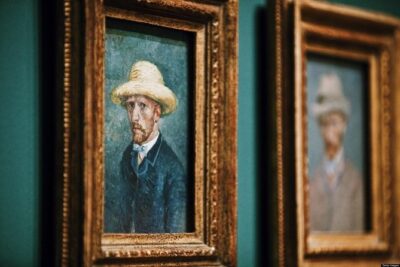
Van Gogh Museum Tour Reserved Entry Semi Private
Read our review →
Combo Ticket: Van Gogh Museum Ticket and 1-Hour Canal Cruise
Read our review →
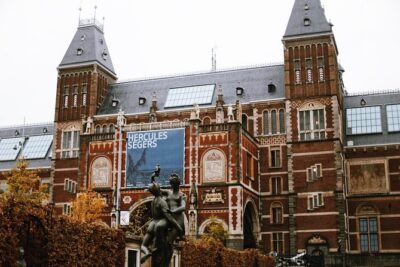
Van Gogh & Rijksmuseum w/ Reserved Entry Semi-Private 8ppl Max
Read our review →
Van Gogh Museum Amsterdam Small Group Guided Tour
Read our review →Browse the lists this tour appears in