
Reviewed · VAN GOGH MUSEUM TOURS
Van Gogh Museum Private Tour
Van Gogh’s paintings are easy to recognize, but this private two-hour tour helps you see how his work changed from dark peasant studies to the bright, restless canvases of Arles and Saint-Rémy. You move through the museum in a clear time line, rather than wandering from one famous painting to the next.
I like the chance to ask questions as you go, and I like the carefully chosen route through works such as The Potato Eaters, Sunflowers, The Bedroom, Iris, and Wheatfield with Crows. The main drawback is the price: at $263.20 per person, it is a serious splurge for two hours, especially when compared with entering the museum alone.
Key points at a glance
- A private guide keeps the visit personal: Only your group takes part, so the pace and questions can fit your interests.
- The route follows Van Gogh’s artistic life: You move from his early Dutch paintings through Paris, Arles, Saint-Rémy, and Auvers.
- The Potato Eaters gets proper attention: The first-floor section explains Van Gogh’s early interest in Millet, Jules Breton, and rural workers.
- The whisper system helps in busy galleries: You can hear the guide without needing to stand right beside the group.
- The tour is short but focused: Six sections of about 15 to 20 minutes make it useful between other Amsterdam plans.
- Adult visitors only: Everyone taking part must be at least 18 years old.
Starting at Cobra Café near Museumplein
The tour begins at Cobra Café, at Hobbemastraat 18, close to Amsterdam’s Museumplein. The museum itself is at Museumplein 6, so the start and finish are in the same general cultural district.
That location makes the tour easy to fit into a day built around the Rijksmuseum, the Stedelijk Museum, or the Concertgebouw area. The meeting point is also near public transportation, which matters in Amsterdam, where a short trip can involve trams, bikes, and busy pedestrian routes.
Allow a little extra time to find the café and meet your guide. Confirmation is sent within 48 hours of booking, subject to availability. The experience is private, meaning only your own group participates, but the supplied details do not state the maximum group size.
The visit lasts about two hours. That is long enough for a meaningful look at the permanent collection, but short enough to leave room for lunch or another museum. It is a good choice if you want structure without giving up most of your day.
More ways to see the Van Gogh Museum:
- Amsterdam: Van Gogh Museum Ticket and City Canal Cruise
★ 4.6 · 3,899 reviews - Amsterdam: Van Gogh Museum Ticket & Canal Cruise
★ 4.5 · 3,304 reviews - Van Gogh Museum Amsterdam Exclusive Tour w/ Reserved Entry
★ 5.0 · 1,760 reviews
Self-portraits: meeting Van Gogh face to face
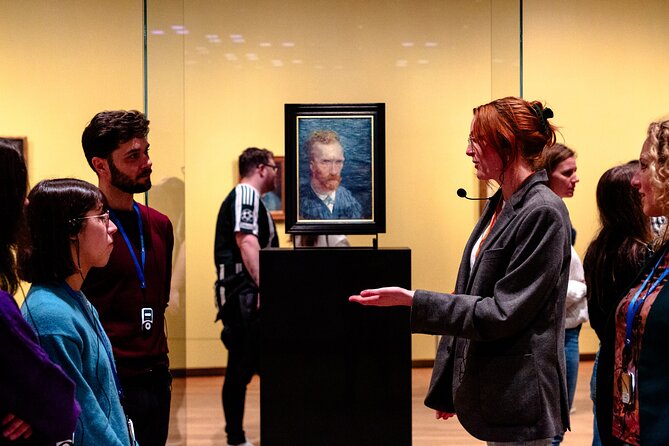
The first stop focuses on Van Gogh’s self-portraits and lasts about 20 minutes. This is a smart place to begin because the paintings give you an immediate sense of how he presented himself and how his technique shifted over time.
A guide can point out changes in color, brushwork, clothing, and mood. You are not simply looking at a famous face. You are watching an artist use his own image as a practical subject, returning to it again and again as his style developed.
This opening section also helps you get used to the museum’s rhythm. Instead of racing straight toward Sunflowers, you begin with the artist himself. I find that useful because it puts the later paintings in a more personal frame.
The 20-minute timing is enough for a clear introduction, though not enough for every self-portrait in detail. If self-portraiture is your main interest, use your private guide time to ask which paintings deserve a closer look.
The Potato Eaters and Van Gogh’s Dutch beginnings
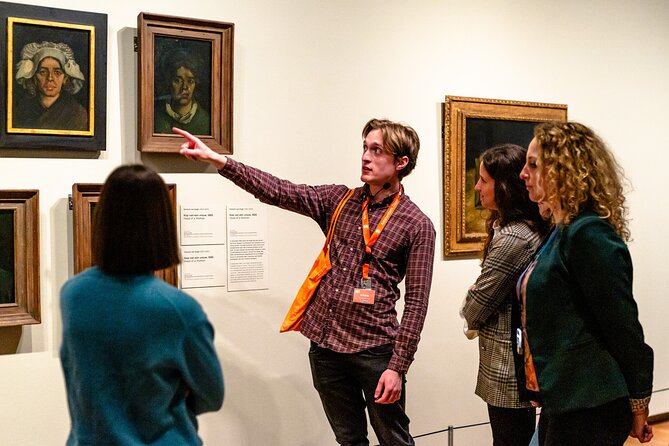
The second section takes place in the first-floor foyer and lasts another 20 minutes. It includes paintings by Jean-François Millet and Jules Breton, Woman Lifting Potatoes, the wall of portraits titled Head of a Peasant Woman, and The Potato Eaters.
This is one of the most useful parts of the route because it shows Van Gogh before the vivid yellows and swirling lines most people associate with him. His early work is heavier, darker, and closely tied to farmers, labor, and ordinary rural life.
The Potato Eaters is the key work here. A guide can help you see why the rough faces, dim room, and earthy colors matter. Van Gogh wanted the figures to look as if they had worked for their food, not as if they were polished models posing for a pretty scene.
The nearby work by Millet and Breton gives you a comparison point. You can see the artistic tradition Van Gogh admired and how he borrowed subjects while developing his own way of handling them.
Twenty minutes passes quickly in this room. You will get the main ideas, but you should not expect a full lecture on every painting. The advantage of a private visit is that you can tell the guide if rural life, portraiture, or artistic influence interests you most.
Paris from 1886 to 1888: brighter color and new ideas
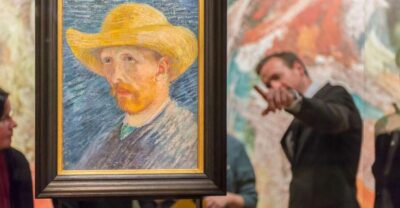
The next stop follows Van Gogh’s move to Paris between 1886 and 1888. The group sees Self Portrait with Felt Hat, Still Life with Absinthe, In the Café: Agostina Segatori in Le Tambourin, and Garden with Courting Couples.
This is where the visual change becomes clear. Van Gogh’s palette grows lighter, and his contact with new art in Paris pushes him away from the dark tones of his Dutch period.
Self Portrait with Felt Hat gives you another chance to compare his face and brushwork with the earlier portraits. Still Life with Absinthe and the café scene bring in urban subjects, while Garden with Courting Couples adds a more open, social setting.
I like this section because it connects style to place. Van Gogh did not change in isolation. Paris exposed him to different colors, artists, and ways of seeing. The guide can explain that shift while keeping the discussion tied to the paintings in front of you.
The 20-minute slot encourages a brisk pace. You will see the main works and understand the change, but you may want to return to one or two paintings later if the museum’s rules allow it. Your guide’s explanation is the main value here, not an attempt to cover every Paris-era detail.
More museums and galleries in Amsterdam:
- Amsterdam: The Upside Down Museum Entrance Ticket
★ 4.4 · 9,506 reviews - Amsterdam: Red Light Secrets Museum Entry Ticket
★ 4.2 · 5,722 reviews - Amsterdam’s Weirdest Museum: Believe It or Not!
★ 4.5 · 4,086 reviews - Amsterdam: NEMO Science Museum Ticket
★ 4.4 · 2,979 reviews
Arles and the South of France in 20 minutes
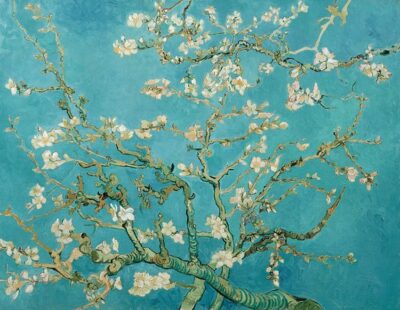
The fourth section covers Van Gogh’s move to Arles in 1888 and includes some of the museum’s best-known paintings: Sunflowers, Almond Blossoms, The Bedroom, Japanese print copies, and The Yellow House.
This is the point where many people feel they have arrived at the Van Gogh they expected. The colors are stronger, the marks more urgent, and the paintings feel tied to heat, light, rooms, gardens, and hope.
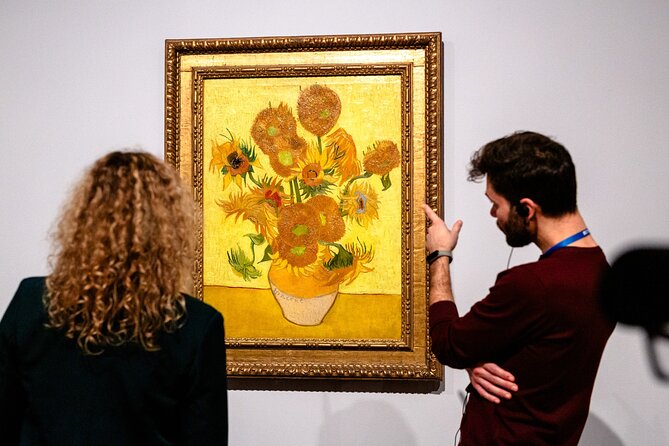
Sunflowers needs no introduction, but a guide can help you look beyond its fame. Notice how the flowers, vase, background, and brushwork work together. The Bedroom offers a completely different mood. Its simple furniture and tilted space turn an ordinary room into something strangely personal.
The Japanese paintings are especially useful for understanding Van Gogh’s interests. He made copies from prints, adapting ideas rather than simply reproducing them. That gives you a direct way to see how outside influences entered his work.
The Yellow House brings the story back to place and ambition. Van Gogh imagined a shared artistic home in Arles, and the painting carries some of that larger plan. In a short tour, you will not get every detail of the period, but you will see how the art and the setting connect.
This section can be crowded around the most famous works. The whisper system is helpful because you can hear the guide without requiring everyone to stand shoulder to shoulder. Still, you should expect to keep moving rather than claim a long, quiet viewing period.
Saint-Rémy on the third floor
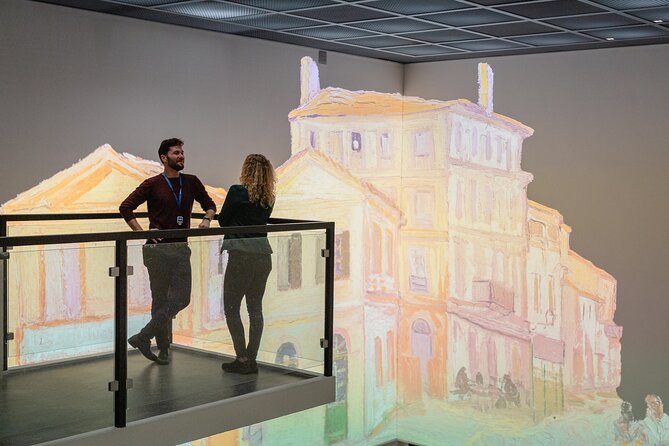
The fifth stop moves to the third floor and covers Van Gogh’s period in Saint-Rémy-de-Provence. It includes another Almond Blossoms, Wheatfield with a Reaper, Iris, and Pieta, after Delacroix.
This section changes the tone again. The paintings carry strong movement and color, but the subjects can feel more charged. A guide can help you compare the calm beauty of Almond Blossoms with the force of Wheatfield with a Reaper and the formal source behind Pieta.
The reference to Delacroix matters. Van Gogh was not only painting what he saw around him. He also responded to earlier artists and reworked their ideas in his own language. That makes Pieta a good example of how his imagination reached beyond direct observation.
The third-floor location means you are farther along in the museum’s chronological route. By this point, the tour has shown you several changes in color, subject, and mood. I like the way this helps you read the later paintings as part of a career, rather than as isolated masterpieces.
You have about 20 minutes here. It is enough for comparisons, questions, and a focused explanation, but not enough to study each painting at length. If you already know Van Gogh’s life well, ask your guide to spend more time on technique or artistic influences.
Auvers and the final paintings
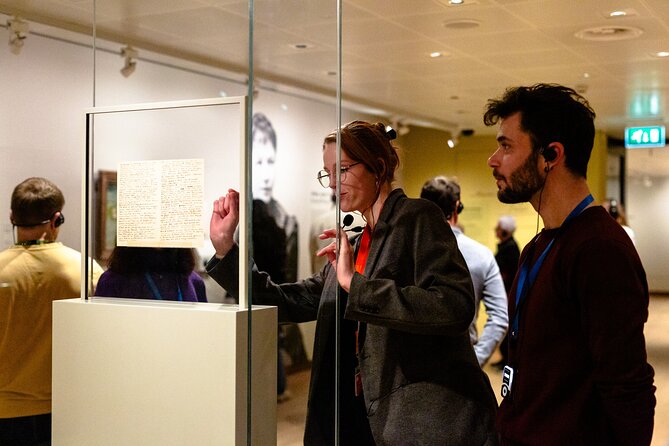
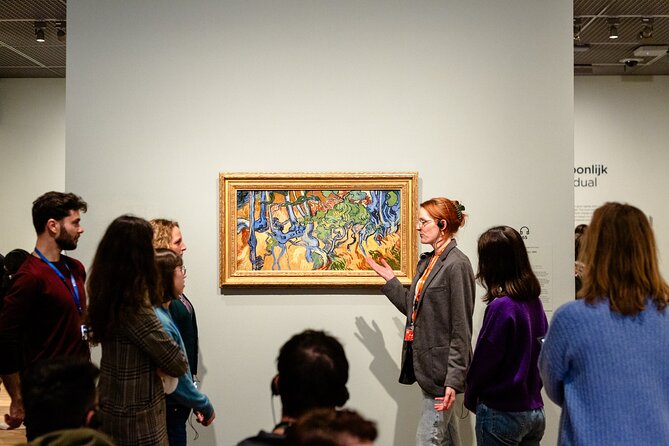
The final section takes about 15 minutes in the Auvers room on the third floor. It includes Tree Roots and Wheatfield with Crows.
This is a short ending, but a strong one. These paintings invite close attention to line, movement, and the way the whole surface seems to press forward. The guide can help you look at how the brushwork carries emotion without reducing the paintings to simple biography.
Wheatfield with Crows is one of the works many people hope to see. It is tempting to treat it only as a final statement about Van Gogh’s life, but the painting deserves attention as a work of color, direction, and space. A private guide can keep the discussion balanced between story and visual evidence.
Tree Roots gives you a different kind of ending. Its tangled forms make you slow down and look closely. With only 15 minutes, the group will move on fairly soon, so note any question you want to ask before the tour ends.
After the visit, you are not allowed to remain in the museum if you are carrying thick winter jackets, suitcases, large bags, or liquids. If you enter lightly with only a small jacket and small handbag, you may stay until closing time. This is an important practical distinction. Pack carefully if you hope to continue looking at the collection after the guide leaves.
What the private format adds
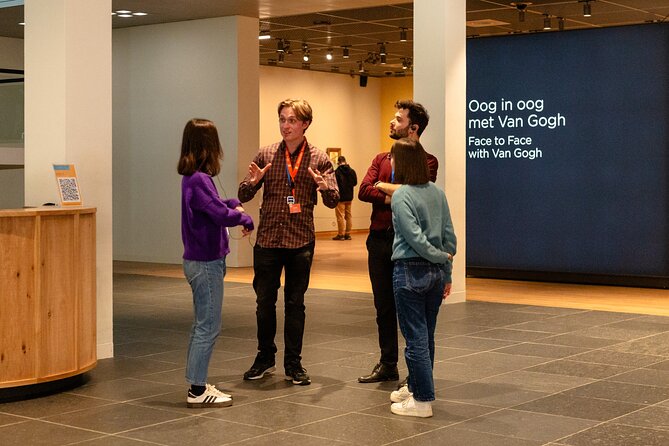
A museum audio guide gives you information, but it cannot respond when you want to compare two paintings or ask why a particular work matters. This private tour gives you a person who can adjust the explanation and answer questions as you go.
The supplied guide names include Sylvia, Giulia, and Kiran. Sylvia’s approach is described as interactive and light, while Giulia is associated with an easy pace and clear explanations. Kiran’s tours focus on keeping a small group moving while still making time for questions.
Those details point to the main strength of the experience: the guide is not just reading a script. The whisper system also helps. You can hear the explanation clearly while looking at the paintings instead of crowding around the guide.
The private format does not guarantee unlimited time at every work. The itinerary is tightly timed, with most sections lasting 20 minutes and the final one lasting 15. Think of it as a guided framework, not a slow art seminar.
Is $263.20 per person a fair price?
At $263.20 per person, this tour costs much more than a standard museum visit. The price makes sense only if you place real value on a private guide, a planned route, and the chance to ask questions.
For a first visit, the structure can save time and prevent the museum from becoming a blur of famous names. You get a clear path through Van Gogh’s early Dutch work, Paris period, Arles paintings, Saint-Rémy works, and Auvers ending.
The value is weaker if you already know the collection well, prefer to read wall text at your own pace, or want several quiet hours with the art. The tour is also offered in English, and the activity is restricted to adults 18 and older.
Group discounts are available, which may improve the cost for a larger private party. Since the exact discount is not provided, check the price for your group before booking rather than assuming the per-person rate will change by a fixed amount.
Who should book this museum visit?
I would recommend it to adults who want a clear introduction to Van Gogh and prefer conversation to a recorded audio device. It also suits couples or small groups who want the guide’s full attention and have limited time in Amsterdam.
The tour is a good fit if you like to ask why a painting looks the way it does, how Van Gogh’s style changed, or how artists influenced him. It is less suitable if you want to linger quietly at a single painting or spend the whole day in the museum.
Plan this as a focused cultural stop, not a casual drop-in. Wear or carry as little as possible, arrive at Cobra Café with time to spare, and decide in advance which subjects matter most to you. That helps the guide use the short visit well.
Cancellation and practical details
You can cancel for a full refund up to 24 hours before the local start time. Changes or cancellations made less than 24 hours before the experience are not accepted for a refund.
Food and drinks are not included. The tour is near public transportation, and most people can participate, though the supplied information does not give further mobility details.
Should you book the Van Gogh Museum Private Tour?
Book it if you want the museum’s major Van Gogh works placed into a clear story, and if the private attention is worth the premium price. Sylvia, Giulia, and Kiran are named as guides connected with the experience, and the strongest qualities are their ability to explain the art, answer questions, and keep the pace comfortable.
Skip it if you would rather save money, use the museum’s own audio option, or spend far longer than two hours with the collection. For everyone else, this is a compact, well-planned way to see how Van Gogh moved from The Potato Eaters to Wheatfield with Crows without losing the thread along the way.
FAQ
Where does the Van Gogh Museum private tour start?
The tour starts at Cobra Café, Hobbemastraat 18, 1071 ZB Amsterdam, Netherlands.
Where does the tour end?
The tour ends at the Van Gogh Museum, Museumplein 6, 1071 DJ Amsterdam, Netherlands.
How long does the tour last?
The guided museum visit lasts about two hours.
Is admission to the Van Gogh Museum included?
Yes. Admission tickets are included for the listed museum stops.
Is the tour private?
Yes. Only your group participates in the private activity.
What language is offered?
English is offered. The included information also describes a private guide in your chosen language, so confirm the available language when booking.
Are children allowed to join?
No. This tour is available only to adults aged 18 and older.
Can I cancel for a refund?
Yes. You can cancel up to 24 hours before the experience start time for a full refund. Cancellations made less than 24 hours before the start are not refunded.
Newest Amsterdam write-ups
- e-Scavenger hunt Amsterdam: Explore the city at your own pace★ 4.5 · 14 reviews
- Amsterdam-West Food Tour with local guide★ 5.0 · 16 reviews
- Private Tour of Simonehoeve Cheese Farm and Clog Factory★ 4.5 · 15 reviews
- Discover Holland’s Beautiful Tulip Fields with an Expert Guide★ 5.0 · 100 reviews
- Van Gogh Museum Guided Visit Including Tickets★ 4.5 · 9 reviews
- Virtual Reality Experience in Netherlands★ 5.0 · 4 reviews
- Daily group bike tour in Spanish.★ 5.0 · 60 reviews
- Van Gogh Museum, Small Group Tour (incl timed entry tickets)★ 5.0 · 5 reviews
Van Gogh Museum Tours, compared.
Van Gogh Museum Amsterdam Exclusive Tour w/ Reserved Entry
Read our review →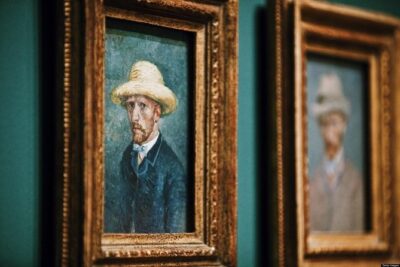
Van Gogh Museum Tour Reserved Entry Semi Private
Read our review →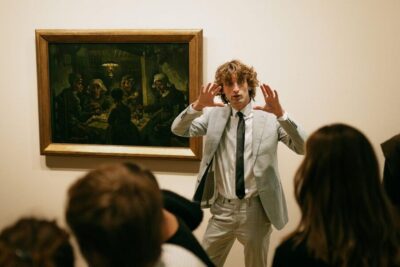
Combo Ticket: Van Gogh Museum Ticket and 1-Hour Canal Cruise
Read our review →

Van Gogh Museum Guided Tour & Entry Ticket (Max 6 ppl)
Read our review →
Van Gogh & Rijksmuseum w/ Reserved Entry Semi-Private 8ppl Max
Read our review →Browse the lists this tour appears in