
Reviewed · AMSTERDAM CANAL CRUISES
Amsterdam: Exclusive Tulip Tour Canal Cruise
Amsterdam’s canals look good from the street, but they make more sense from the water. This small-group cruise takes you past houseboats, leaning canal houses, the Amstel, the Seven Bridges, and the grand mansions of the Herengracht, all from a boat dressed with lifelike tulips.
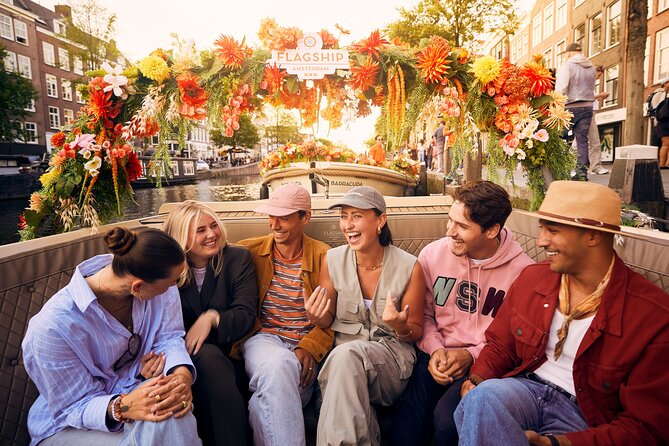
I like the maximum of 10 passengers, which keeps the ride more personal than a large sightseeing boat. I also like the photo-friendly tulip setting, especially at the 8 p.m. departure, when one passenger found the sunset light especially appealing. The main concern is seasonal: the tulip boat may not operate in winter, even though the artificial flowers remain part of the concept.
Past departures have featured skippers and guides named Tim, Wes, Bart, and Abel, with praise for their friendly manner and clear local commentary. Drinks cost extra, and the one-hour trip returns to the same meeting point at Prins Hendrikkade 33A.
Key points to know before booking
- The boat holds up to 10 people, giving you a quieter ride and a better chance to hear the skipper.
- Lifelike tulips cover the boat, creating a playful setting for photos rather than a traditional sightseeing cruise.
- The route includes major canal sights, from Oosterdok and the Amstel to the Seven Bridges and the Golden Bend.
- Guides such as Tim, Wes, Bart, and Abel have received strong praise for friendly, engaging commentary.
- The fare is $37.80 per person, with drinks available separately from the onboard bar.
- Winter availability needs checking, since poor weather and strong winds can cancel the tulip boat service.
Why this tulip boat feels different from a standard canal ride
Many Amsterdam canal cruises are designed around a fixed sightseeing format: large boat, long glass roof, rows of seats, and a steady stream of landmarks. This trip takes a smaller and more decorative approach. The tulips are artificial, but that is not really the point. They turn the boat into a bright photo setting and give the ride a cheerful spring theme even when you are not visiting during tulip season.
The small size matters more than the flowers. With no more than 10 people aboard, you are not packed into a large cabin with dozens of other passengers. You have a better chance of hearing the skipper’s stories and asking a question without making a formal production of it.
This is still a short introduction to Amsterdam, not a full history tour. In about one hour, you will see a lot from the water, but the commentary will naturally be selective. I would choose it for atmosphere, city views, and a compact orientation rather than for a deep study of Amsterdam’s past.
More tulip field trips in spring:
- Amsterdam: Keukenhof, Tulip Farm Full-Day Tour with Cruise
★ 4.5 · 452 reviews - Keukenhof Gardens & Tulip Experience Tour from Amsterdam
★ 4.5 · 267 reviews - From Amsterdam: Keukenhof Gardens & Tulip Experience Tour
★ 4.6 · 249 reviews
Starting at Oosterdok beside Amsterdam’s old harbor
The meeting point is at Prins Hendrikkade 33A, near Oosterdok. This part of Amsterdam once served as a 19th-century harbor. Today, it brings together older maritime character and newer buildings, including the NEMO Science Museum and the National Maritime Museum.
Oosterdok is a useful starting point because it quickly reminds you that Amsterdam grew through water. You see working waterfront spaces, boats, and modern architecture before the route moves into the older canal network.
The first minutes also help you settle into the boat. Since the ride lasts only about an hour, the skipper needs to keep the route moving. Do not expect a long stop at each sight. The value comes from seeing several parts of the city in one continuous trip.
If you are deciding when to go, the later departure can be appealing. An 8 p.m. ride has been especially attractive around sunset, when the canals and narrow buildings take on softer light. Exact conditions depend on the date and weather, but the timing can make the tulips and canal scenery photograph particularly well.
Houseboat Alley and Amsterdam life on the water
One of the most distinctive parts of the route is Houseboat Alley. Here, homes sit directly on the canals, showing how Amsterdam’s relationship with water is not just historic or decorative. It is part of daily life.
Houseboats give you a different view of the city’s housing tradition. Instead of looking only at grand merchant homes, you see residences built around the waterways themselves. The scene is especially easy to appreciate from a small boat, since the low profile puts you close to the canal edge.
There is a practical limitation. A one-hour cruise cannot linger in every residential stretch, and the route may pass through Houseboat Alley fairly quickly. Keep your camera ready rather than waiting for a formal stop.
The Amstel and the city’s origin story
The cruise also reaches the Amstel, the waterway at the heart of Amsterdam’s name and early development. Amsterdam grew around the river, where a dam was built to manage the water. The name Amsterdam reflects that basic story: a dam on the Amstel.
This is one of the moments when the city’s layout becomes easier to understand. Amsterdam can seem like a maze of canals when you are walking. From the boat, the waterways show how the settlement expanded outward from its central river and dam.
The Amstel is wider than the narrow canal sections, so you get a change of pace and a broader view. That variety helps keep the hour interesting. You are not looking at the same type of waterway from start to finish.
More canal cruises in Amsterdam:
- Amsterdam Luxury Canal Cruise + Unlimited Drinks & Bites option
★ 5.0 · 30,518 reviews - Amsterdam: 75 Minute City Canal Cruise with Audio Guide
★ 4.4 · 17,501 reviews - Amsterdam: City Centre Canal Cruise
★ 4.2 · 12,827 reviews - Amsterdam Canal Cruise in Open Boat with Unlimited Drinks Option
★ 5.0 · 4,976 reviews
Why Amsterdam’s houses lean
The tilted canal houses are among the city’s most recognizable sights, and the skipper explains why they do not always stand straight. Amsterdam was built on marshy ground, where heavy structures sink. Builders used wooden poles to reach a deeper, firmer layer that could support the houses.
Over time, some buildings shifted or settled unevenly. The result is a row of narrow facades that may lean forward, sideways, or both. From the canal, the effect is easy to spot because the buildings rise directly beside the water.
This explanation adds value to what might otherwise be just a quirky photo opportunity. Look closely at the upper floors and rooflines. The buildings can appear to be tipping toward the canal, yet their unusual angles are part of the city’s long effort to build securely on soft ground.
The Stopera and Amsterdam’s modern civic center
The route passes the Stopera, a name formed from the Dutch words for city hall and opera. The complex combines those two functions in one large civic and cultural building.
It is a useful contrast with the old canal houses. Amsterdam is not simply an open-air display of 17th-century facades. Modern public buildings, cultural venues, and newer waterfront spaces sit alongside the old canal ring.
From a moving boat, you will not study the architecture in detail, but you will get a clear sense of how the city layers old and new. That contrast is one reason a canal route works so well. The water links districts that can feel separate when you explore only on foot.
The Seven Bridges after Thorbecke Bridge
After Thorbecke Bridge, the boat reaches the famous Seven Bridges view. Under the right conditions, and without other boats blocking the sightline, you can see seven similar stone bridges lined up one behind another.
This is one of the route’s best photo moments, but it is also one of the least predictable. Canal traffic matters. If another boat is in the way, the full row may not be visible, so treat it as a lucky view rather than a guaranteed posed photograph.
The small boat helps here. A group of 10 can shift attention quickly when the skipper points out the bridges, and you are more likely to feel part of the moment than in a large enclosed vessel.
The Golden Bend and Herengracht mansions
The Golden Bend of the Herengracht offers the most polished architecture on the route. This stretch is known for large canal mansions built by wealthy Amsterdam families, with grand facades and generous proportions.
The contrast with Houseboat Alley is striking. Earlier, you see homes shaped by practical life on the water. Here, the canals frame displays of money, status, and historic ambition.
The Herengracht is one of the best places to simply look upward. Notice the differences in gables, windows, brickwork, and facade width. The canal makes it easier to view the buildings from a consistent angle, without crossing streets or weaving through pedestrians.
For many people, this will be the visual high point of the ride. The tulip-covered boat adds color in the foreground, while the canal mansions provide the older, more formal backdrop.
What the guides add to a one-hour trip
The skipper is included, and the cruise is offered in English. The strongest part of the commentary depends on the person at the helm, but past departures have been led by Tim, Wes, Bart, and Abel.
Tim received praise for being friendly and capable. Wes was singled out for an energetic manner, while Bart was appreciated for guiding and driving on a clear day. Abel was described as a relaxed guide who added useful information without making the trip feel stiff.
Those details matter because one hour leaves little room for poor pacing. A good skipper needs to point out the sight before it disappears behind a bridge or another boat. The best guides also make the facts feel connected to what you are seeing, such as explaining the leaning houses while you are passing them.
Do not book this as a silent ride. You are paying partly for the boat setting and partly for the live explanation. If you want a private, highly detailed history lesson, this is not that. If you want a friendly introduction with local context, it fits better.
The tulips, photo opportunities, and onboard bar
The tulips are the defining visual feature. They are lifelike artificial flowers arranged around the boat, so you can use them as a colorful foreground for canal photographs.
The setup has clear appeal if you enjoy taking pictures. The combination of flowers, water, bridges, and narrow facades gives you more than the usual canal snapshot. You do not need to wait for Amsterdam’s outdoor tulip season to get the floral theme.
At the same time, the flowers are decoration, not a substitute for seeing real tulip fields. This cruise does not take you outside Amsterdam to the bulb-growing region. Book it for a tulip-themed city ride, not for a countryside flower excursion.
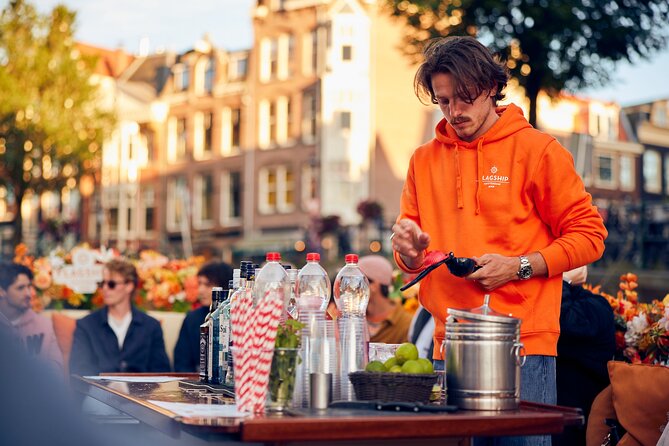
An onboard bar sells a variety of drinks. These are not included in the $37.80 fare, so plan to pay separately if you want one. The bar can add a pleasant social touch, but you do not need to buy anything to take the cruise.
Is $37.80 a fair price?
At $37.80 per person, this is not the cheapest way to sit on an Amsterdam canal. The value comes from the small capacity, the themed boat, the live skipper, and the number of sights covered in one hour.
A large public cruise may offer a lower price, but it can feel less personal. Here, the maximum of 10 people gives you more breathing room and a better view of the guide. If photos and atmosphere matter to you, the tulip setting helps justify the extra cost.
The trip is also efficient. In a single hour, you see Oosterdok, Houseboat Alley, the Amstel, the Stopera, the Seven Bridges, and the Golden Bend. You will not explore each place on foot, but you will get a useful overview without spending half a day.
I would consider the price reasonable for a couple, a small group of friends, or anyone who wants a short, distinctive canal experience. It is less compelling if you only care about the lowest fare or want a long cruise with a full meal included.
Timing, weather, and the important winter warning
This experience depends on good weather. If poor conditions cause a cancellation, you are offered another date or a full refund. That policy is helpful, but you still need a backup plan for a day when wind or rain affects the canals.
The winter issue deserves special attention. The tulips are artificial, but the operator has explained that the tulip boat may not run during winter because of strong winds and bad weather. One booking was made when the themed boat was unavailable, creating a serious mismatch between what was expected and what operated.
If you are booking for a winter date, confirm that the tulip boat is actually running before you rely on the floral theme. This is the single most important practical check for the experience.
You can cancel for a full refund up to 24 hours before the start time. Cancellations or changes inside that period are not refunded, and the cut-off uses Amsterdam local time. An injury-related cancellation was handled with only a partial refund, so do not assume that a late cancellation will receive special treatment.
Who will enjoy this cruise most
I would recommend this trip to you if you want:
- A short first look at Amsterdam from the water
- A small boat rather than a large sightseeing vessel
- A colorful setting for photographs
- Live English commentary from a skipper
- A relaxed outing for a couple or small group
- A convenient activity that returns to its starting point
It is also a good choice after a long day of walking. You can sit back, cover several central sights, and let the canal route do the work.
I would hesitate if you want real tulip fields, a lengthy historical tour, or a guaranteed winter departure on the decorated boat. You should also think twice if weather is likely to disrupt your plans and you have no flexibility.
Should you book the Amsterdam Exclusive Tulip Tour?
Book it if you want a compact, photogenic canal ride with no more than 10 people and a friendly English-speaking skipper. The tulips give the boat a playful look, while the route supplies the substance: the Amstel, houseboats, tilted houses, the Seven Bridges, and the Golden Bend.
Before paying, check the date carefully, especially in winter. If the boat is confirmed and the weather looks promising, $37.80 is a fair price for a one-hour introduction that feels more personal than a standard large-boat cruise. If the tulip boat is unavailable, ask what vessel and experience will actually operate before you commit.
FAQ
How long is the Amsterdam Exclusive Tulip Tour?
The canal cruise lasts approximately one hour.
Where does the cruise start?
It starts at Prins Hendrikkade 33A, 1012 AB Amsterdam, Netherlands.
Where does the cruise end?
The activity ends back at the same meeting point.
How many people can join the cruise?
The boat has a maximum capacity of 10 travelers.
Are drinks included in the ticket price?
No. Drinks are available for purchase from the onboard bar.
What happens if bad weather cancels the cruise?
You will be offered a different date or a full refund if the activity is canceled because of poor weather.
Newest Amsterdam write-ups
- Zaanse Schans: Half-Day Private Guided Tour★ 5.0 · 4 reviews
- Zaanse Schans: Private Cruise + Live Guide, Optional Drinks★ 4.7 · 26 reviews
- Zaanse Schans: Wooden Shoe Painting Workshop★ 4.9 · 23 reviews
- Amsterdam: Private Zaanse Schans Windmills and Volendam Trip★ 4.9 · 31 reviews
- Zaanse Schans: Pancake Restaurant Visit★ 4.5 · 26 reviews
- Amsterdam: Zaanse Schans E-Bike Tour with Windmills & Cheese★ 4.5 · 12 reviews
- Zaandam: Paint a Perfect Portrait workshop★ 5.0 · 5 reviews
- Amsterdam Central Walking Tour★ 4.9 · 11 reviews
Amsterdam Canal Cruises, compared.
Amsterdam Luxury Canal Cruise + Unlimited Drinks & Bites option
Read our review →
Amsterdam Canal Cruise in Open Boat with Unlimited Drinks Option
Read our review →

Amsterdam Evening Canal Cruise with Live Guide and Onboard Bar
Read our review →
Amsterdam Canal Cruise With Live Guide and Unlimited Drinks
Read our review →
Amsterdam Small-Group Canal Cruise Including Snacks and Drinks
Read our review →Browse the lists this tour appears in