
Reviewed · AMSTERDAM HISTORY WALKING TOURS
Amsterdam High-End Dutch Food & History Tour – Up to 8 guests
Amsterdam’s best food lessons often come between the famous sights. This four-hour walk links a brown café, market stalls, cheese counters, fish shops, and old city landmarks, turning everyday Dutch food into a story about trade, colonies, working-class life, and local habits. You may finish knowing what ossenworst is, why Indonesian food belongs in Amsterdam’s culinary story, and how to order herring without blinking.
I love the way the tour moves beyond the usual fries and waffles, and I like the small maximum of eight people. Guides including Rudolph, Catharina, Jan, David, Caroline, and Mark have been praised for mixing food with architecture and city history without turning the walk into a lecture.
The main thing to consider is the price: $157.21 per person is a serious investment for four hours. You also need to stand and walk for up to 20 minutes at a time, and this is not a good match for a vegan diet.
Key points at a glance
- A six-stop taste of Amsterdam: Expect apple pie, Dutch cheese, sausage, seafood, Indonesian satay, and bitterballen, with the exact route based on the day.
- The food is tied to place and history: The walk connects Dutch colonial trade, market culture, old cafés, and the former headquarters of the Dutch West India Company.
- Small groups matter: With no more than eight people, it is easier to ask questions and speak with the guide.
- Some drinks are included: Dutch wine is paired with cheese on certain days, with beer and non-alcoholic choices available.
- The schedule changes: Saturday focuses on the Lindengracht market, Sunday and Monday use a different set of stops, and Tuesday through Friday offer another route.
- Come hungry: The tastings add up to a substantial half-day meal rather than a few token samples.
Why this walk feels different from a standard Amsterdam food tour
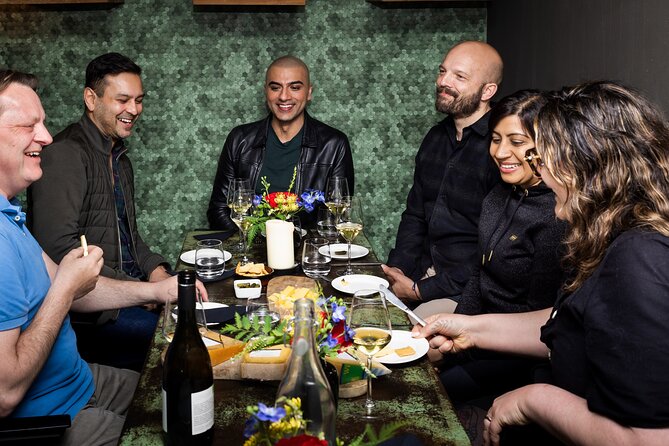
Many Amsterdam food walks build their whole menu around fries, waffles, and perhaps a piece of cheese. This one takes a broader view. You still get apple pie and cheese, but the route also brings in smoked beef sausage, herring, eel, Indonesian satay, shrimp croquettes, and bitterballen.
That mix matters because Dutch food is not one tidy category. Some dishes are simple café fare. Others reflect fishing traditions, old butcher shops, overseas trade, or the long Dutch connection with Indonesia. I like that the tour gives you room to decide what you enjoy rather than pretending every specialty will suit every palate.
The guide is central to the experience. Names that appear repeatedly among the available guides include Rudolph, Catharina, Jan, David, Mark, Caroline, Dirk, Bo, and Jelte. The strongest descriptions point to guides who explain just enough as you walk, keep the group moving, and know the owners at the places you visit.
You should expect a social outing rather than a silent tasting session. The group is limited to eight, which gives you a fair chance to ask about ingredients, customs, and the neighborhoods along the route.
More history walks in Amsterdam:
- Amsterdam: Life of Anne Frank and World War II Walking Tour
★ 4.8 · 10,467 reviews - Amsterdam: Dutch WWII Resistance Museum Entry Ticket
★ 4.7 · 951 reviews - Amsterdam: Highlights & History Walking Tour
★ 4.8 · 266 reviews
Starting with apple pie at Papeneiland
The meeting point is The Papeneiland at Prinsengracht 2. You begin with homemade Dutch apple pie in one of Amsterdam’s best-known brown cafés, the dark, cozy kind of place that feels tied to the city’s older drinking and social culture.
This is a smart first stop. Apple pie is familiar enough to ease you into the day, yet the homemade version gives the guide an easy opening to discuss Dutch café habits and local standards. It also gives you a comfortable seat before the walking and tasting begin.
Do not think of the pie as a small snack that barely counts. The tour serves enough food over four hours that you should arrive with a light appetite. If you eat a full breakfast immediately beforehand, you may struggle by the final stops.
Saturday at the Lindengracht market
Saturday’s route makes special use of the Lindengracht market. Here, you taste Indonesian satay with side dishes, a useful reminder that Amsterdam’s food culture cannot be understood through old Dutch recipes alone.
The Dutch connection with Indonesia shaped restaurants, home cooking, snacks, and spice preferences across the Netherlands. The satay gives you a clear example of that exchange, while the market setting adds a sense of ordinary local life.
A market stop also makes the Saturday experience feel different from the weekday route. You are not simply moving from one reserved indoor table to another. You get a taste in a public food setting, with the tradeoff that markets can be less predictable than a private room.
If you take the Saturday tour, check the day carefully before booking. The Saturday itinerary does not match the Sunday through Monday or Tuesday through Friday versions.
Cheese, Dutch wine, and the value of a guided tasting
The cheese stop is one of the tour’s anchors. You pick up three farmhouse Dutch cheeses from a boutique deli, then taste them with Dutch wine in a private speakeasy room on the days when that tasting is scheduled.
The point is not merely to eat cheese. A guide can explain differences between soft and hard styles, how to pair them, and why cheese remains such a strong part of Dutch food culture. The private room should also make this the most relaxed part of the walk, especially if the streets are wet or windy.
Wine is not the only option. Beer and non-alcoholic choices are available, which makes the tasting more flexible for people who do not want wine. The information provided does not spell out the exact number of pours, so I would treat the beverage element as a complement to the food rather than a full wine tour.
On Sunday and Monday, the cheese course takes a different form. You receive three artisan soft and hard cheeses with crackers, quince pear, and ossenworst, the smoked beef sausage. That version gives you more accompanying flavors but does not list the private Dutch wine tasting.
More food tours in Amsterdam:
- 10 Tastes of Amsterdam: Food Tour by UNESCO Canals and Jordaan
★ 5.0 · 3,020 reviews - Amsterdam Food and Cultural Tour with Tastings
★ 5.0 · 2,442 reviews - Amsterdam Jordaan Food & Drinks Tour with Eating Europe
★ 5.0 · 2,425 reviews - Amsterdam: Premium Henri Willig Cheese Tasting Experience
★ 4.7 · 1,106 reviews
The Sunday and Monday route has its own character
Sunday and Monday replace the market and fish-shop pattern with a series of deli, patisserie, and Indonesian stops. At a boutique deli, you get fresh baguette topped with Dutch grillworst, a warm spiced pork sausage served with honey mustard, mayonnaise, pine nuts, and rocket salad.
This is a filling, assembled bite with more going on than a plain sandwich. Grillworst gives you a look at the Dutch fondness for seasoned sausage, while the toppings make it closer to a composed lunch than a simple sample.
You then try a Dutch shrimp croquette from Patisserie Holtkamp, a long-established Amsterdam name. Croquettes are an important part of Dutch snack culture, and the shrimp version is a useful change from the more familiar beef filling.
The Indonesian portion on these days includes freshly grilled Javanese chicken satay with peanut sauce, cassava kroepoek, and sambal. It finishes with handmade Indonesian spekkoek, a layered cinnamon cake. This pairing gives you both savory and sweet examples of Indonesian influence in Dutch eating.
The final food group combines cheese, crackers, quince pear, ossenworst, pickles, and mustard. If you prefer a route with more variety in texture and seasoning, Sunday or Monday may suit you best.
Tuesday through Friday brings back fish and old food trades
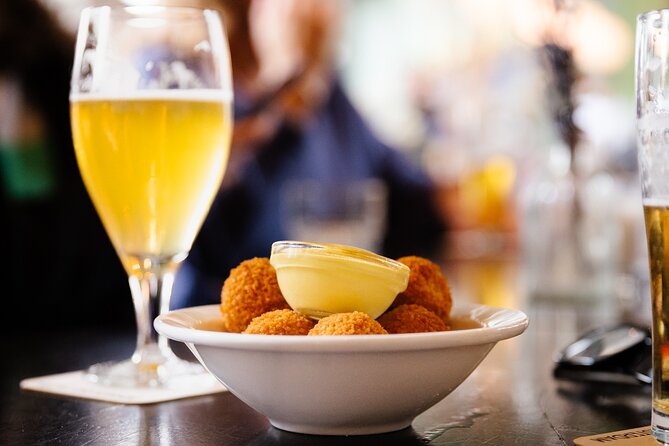
From Tuesday through Friday, the route returns to the three farmhouse cheeses, the Dutch wine tasting, and a seafood stop. Before that, you visit a 130-year-old family butcher shop for ossenworst and grillworst.
The butcher shop is valuable because it connects the tasting to craft and continuity. You are not simply sampling a product from a supermarket counter. You are seeing how sausage fits into the city’s everyday food traditions, while the guide provides the wider context.
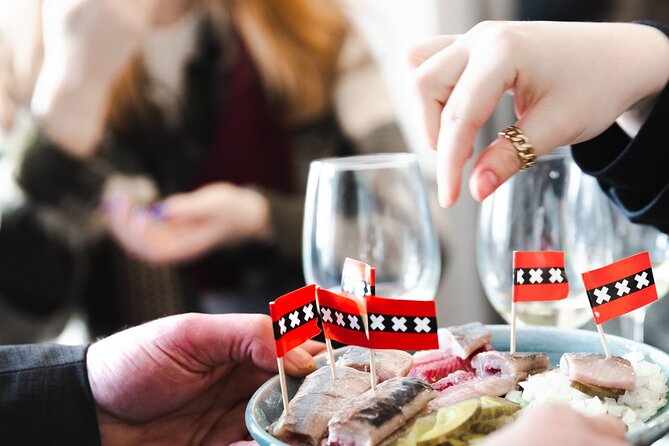
The fish stop covers several Dutch staples: herring, fried cod, and smoked eel. These are very different bites, and that is part of the fun. Herring is fresh and briny, fried cod is familiar comfort food, and smoked eel brings a stronger, richer flavor.
You may love all three, or you may decide that one is enough. This is one of the route’s more useful features: it lets you try foods you might not choose on your own, without committing to a full dish at a restaurant.
The seafood stop also illustrates why a guide helps. Eating herring or smoked eel is not only about flavor. It connects to fishing, preservation, and the practical food traditions of a country shaped by water.
Finishing with bitterballen near Dutch colonial history
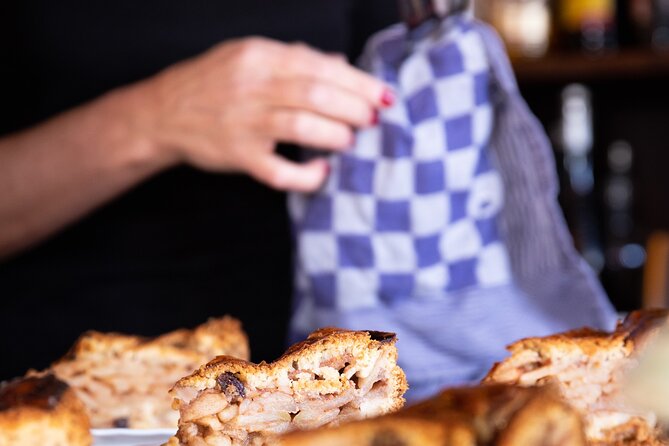
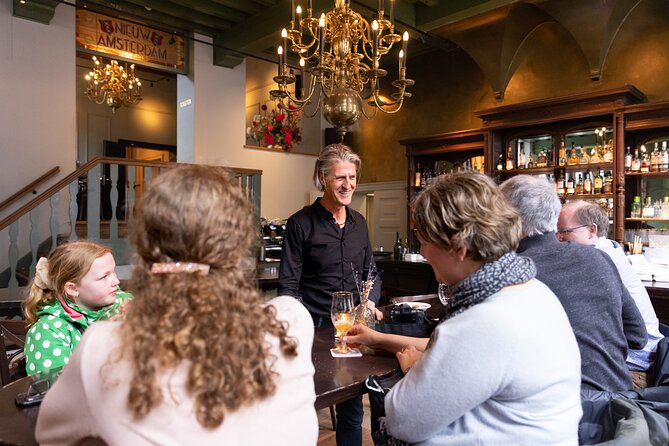
The tour ends at Café Nieuw Amsterdam on Haarlemmerstraat 75. The final tasting is traditional bitterballen at the former 17th-century headquarters of the Dutch West India Company, described as the birthplace of New York.
That setting gives the ending more weight than a random bar stop. Bitterballen are a classic Dutch snack, usually associated with social drinking and casual gatherings, while the building links the meal to Amsterdam’s role in global trade and colonization.
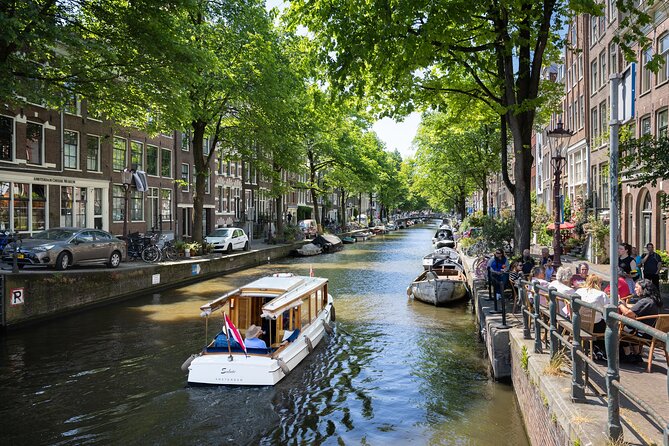
The tour does not treat history as decoration. The stops use food to show how commerce, empire, migration, fishing, markets, and café culture shaped what people eat. I find that more useful than simply hearing dates while staring at a canal.
The ending location also makes practical sense. You finish in central Amsterdam rather than returning to the starting point, so you can continue along Haarlemmerstraat or head elsewhere in the city. The supplied details do not promise transport back to the meeting point, so plan your afternoon from the finish at Café Nieuw Amsterdam.
How much food do you actually get?
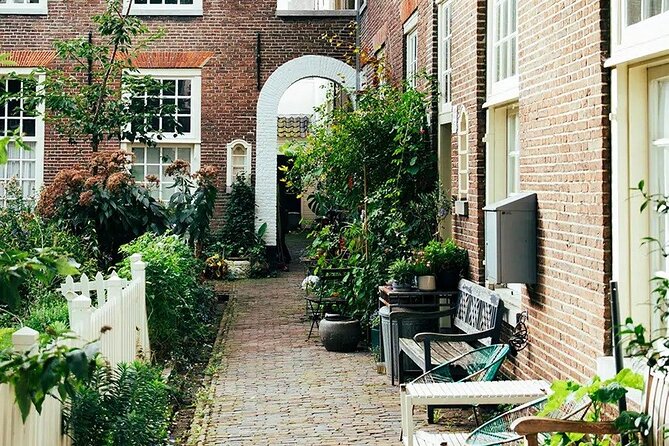
The answer depends on the day, but you should think of this as a generous grazing lunch. Across the routes, you may eat apple pie, sausage, cheese, satay, seafood, croquettes, cake, and bitterballen. Some tastings come with sides, sauces, crackers, fruit, or drinks.
One practical tip is simple: eat lightly beforehand. The food is not presented as a formal multi-course meal, so portions may vary by stop, but the combined amount is substantial.
If you have dietary restrictions, write them down when booking. The tour is not suitable for a vegan lifestyle. Other needs may be accommodated, but the available information does not promise an equal substitute at every stop.
Vegetarians should be especially clear and specific. The butcher shop has no vegetarian options, though an alternative such as extra chocolates has been provided in at least one case. That suggests the operator may adjust the food, but you should not assume every stop will have a like-for-like replacement.
Is $157.21 a fair price?
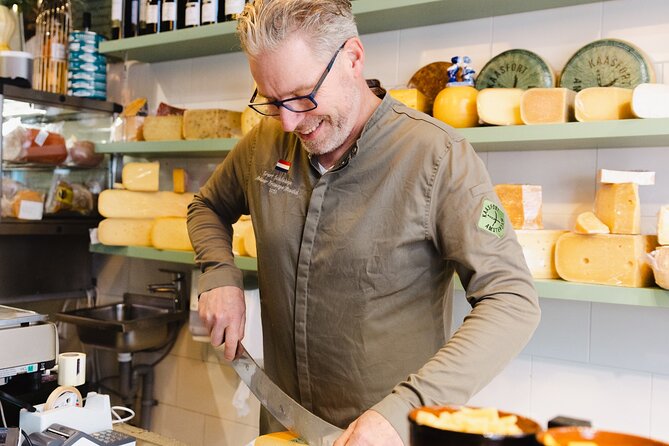
At $157.21, this costs more than a casual market lunch or a self-guided snack crawl. You are paying for six or so food stops, drinks at selected tastings, a four-hour route, a small group, and a guide who adds local food and city context.
The value is strongest if you want guidance. You could buy cheese, herring, and bitterballen yourself for less, but you would need to find the right places, understand what to order, and connect them into a sensible route. You would also miss the explanations about Dutch and Indonesian food traditions.
The price is less compelling if you mainly want a large restaurant meal or if you already know Amsterdam’s food scene well. The menu includes everyday foods, not luxury ingredients at every stop. One useful expectation is that high-end refers partly to selected shops, careful pairings, and access to local specialists, not a succession of expensive dining rooms.
The near-perfect overall rating and repeated praise for guides such as Rudolph, Catharina, Jan, and David suggest that the human element carries much of the value. Guide quality can vary from date to date, but the format gives a good guide plenty of room to make the walk memorable.
Timing, walking, and rainy-day planning
The experience lasts about four hours. You need normal mobility and must be able to walk and stand for up to 20 minutes at a time. This is not a hard hike, but it is not a seated tasting either.
Three of the six food stops have reserved seats and a bathroom. That is useful, though you should not expect a chair at every stop. If you need frequent seating or regular restroom access, contact the operator before booking.
Bad weather does not cancel the food plan. The tastings take place indoors, and the walking distances may be shortened if conditions are poor. You should still dress for Amsterdam weather, since you move between venues.
The activity is offered in English and uses a mobile ticket. It is near public transportation, and service animals are allowed. Confirmation is sent when you book.
Cancellation is free up to 24 hours before the start time. A cancellation inside that window is not refunded, and changes are not accepted. The tour also needs a minimum number of people, so if the operator cancels for that reason, you receive a different option or a full refund.
Who should book this food walk?
I would choose this for a first or second visit to Amsterdam, especially if you like learning through food instead of sitting through a formal museum tour. It suits couples, families, and small groups who want a social half-day with plenty of tasting.
It is also a good choice for adventurous eaters who want an introduction to herring, eel, ossenworst, Indonesian satay, and Dutch snack culture. The small group makes it easier to ask about ingredients and local customs.
I would hesitate if you are vegan, dislike seafood and sausage, or need a fully seated experience. I would also compare the Sunday and Monday route with the Tuesday through Friday schedule before paying, since the foods and setting change quite a bit.
Should you book the Amsterdam High-End Dutch Food and History Tour?
Book it if you want more than a checklist of Dutch snacks. The tour’s best feature is the connection between food and place: a brown café, a family butcher, a market, a fish shop, a cheese deli, and a former company headquarters each add a different piece of Amsterdam.
The strongest reasons to go are the small group, the wide range of tastings, and the guides who bring the city to life through food and history. The main caution is the price, along with the heavy use of meat, seafood, and dairy.
If $157.21 fits your budget and you arrive hungry, this is a well-planned way to spend four hours in Amsterdam. Check the day-specific menu, note your dietary needs, and expect a full meal served as a walk.
FAQ
How long does the Amsterdam food and history tour last?
The tour lasts approximately four hours.
How many people can join the tour?
The maximum group size is eight people.
Where does the tour begin?
The tour begins at The Papeneiland, Prinsengracht 2, 1015 DV Amsterdam.
Where does the tour end?
The tour ends at Café Nieuw Amsterdam, Haarlemmerstraat 75, 1013 EC Amsterdam.
Is the food route the same every day?
No. Saturday includes Indonesian satay at the Lindengracht market. Sunday and Monday include grillworst, shrimp croquette, Javanese chicken satay, spekkoek, and a cheese course. Tuesday through Friday include a family butcher shop, Dutch wine and cheese, fish tastings, and bitterballen.
Are drinks included?
Complimentary craft beer or wine is included at some stops. The cheese tasting on the Tuesday through Friday route includes Dutch wine, with beer and non-alcoholic options available.
Is the tour suitable for vegans?
No. The tour is not suitable for a vegan lifestyle.
What happens if it rains?
All tastings take place indoors in bad weather, and the walking distances between stops may be shortened.
Newest Amsterdam write-ups
- Zaanse Schans: Half-Day Private Guided Tour★ 5.0 · 4 reviews
- Zaanse Schans: Private Cruise + Live Guide, Optional Drinks★ 4.7 · 26 reviews
- Zaanse Schans: Wooden Shoe Painting Workshop★ 4.9 · 23 reviews
- Amsterdam: Private Zaanse Schans Windmills and Volendam Trip★ 4.9 · 31 reviews
- Zaanse Schans: Pancake Restaurant Visit★ 4.5 · 26 reviews
- Amsterdam: Zaanse Schans E-Bike Tour with Windmills & Cheese★ 4.5 · 12 reviews
- Zaandam: Paint a Perfect Portrait workshop★ 5.0 · 5 reviews
- Volendam: Volendams Museum Entry Ticket★ 4.4 · 14 reviews
Amsterdam History Walking Tours, compared.
Life of Anne Frank and World War II Walking Tour
Read our review →
Anne Frank and Amsterdam Jewish History Walking Tour
Read our review →
Small Group Tour to Nazi WWII concentration camp from Amsterdam
Read our review →
Anna Frank and World War II History Walking Tour
Read our review →
Anne Frank and World War II Walking Tour (TOP RATED)
Read our review →Browse the lists this tour appears in