
Reviewed · AMSTERDAM BIKE TOURS
Bill’s Bike Tour Amsterdam – Culture, Liberalism & Tolerance
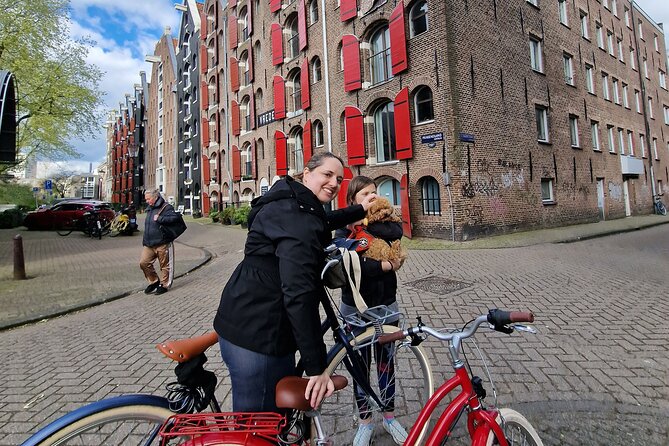
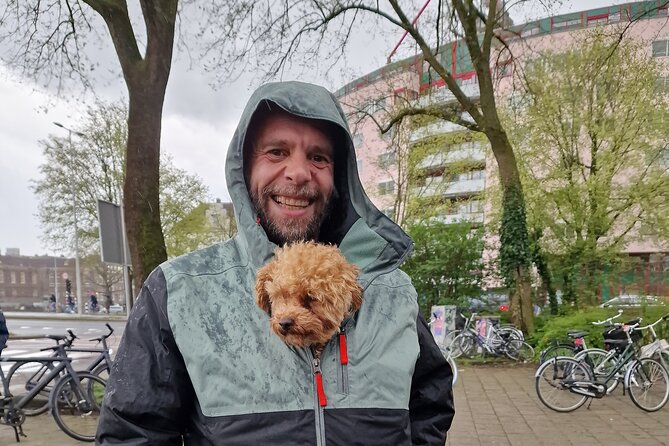
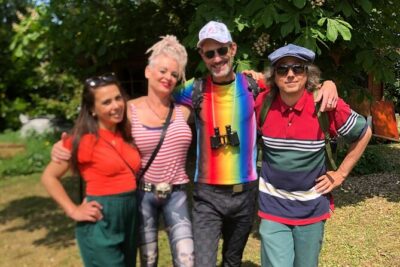
Amsterdam’s most interesting sights on this ride are not the postcard canals. You pedal through old industrial districts, a secret canal quarter, reclaimed waterfront, and the rough-edged NDSM Wharf, with guide Pim, aka Bill, leading the way and his puppy Herman riding along. The ferry crossing adds a welcome change of pace.
I like the small group, capped at 12, and the mix of local history with everyday Amsterdam life. I also like that Bill takes photos and videos, so you can keep your phone in your pocket while riding. The main drawback is simple: this is a three-hour outdoor activity, so cold, rain, or strong wind can affect the experience.
Key points to know before you book
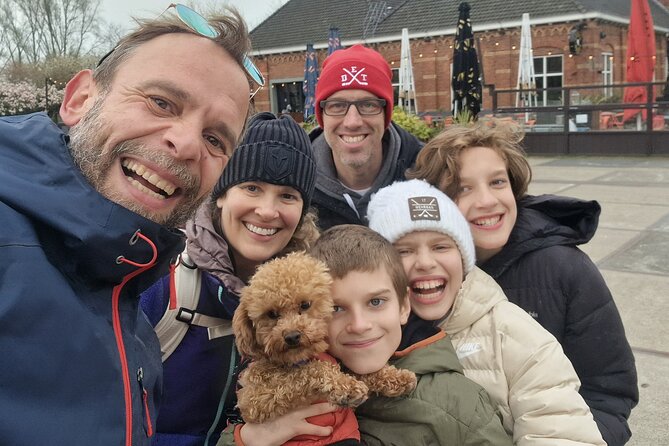
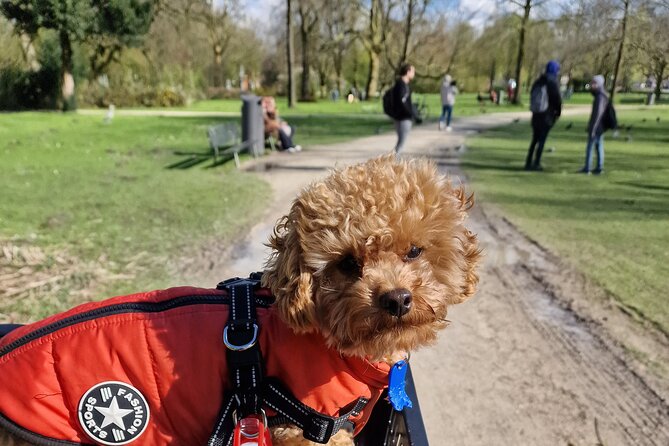
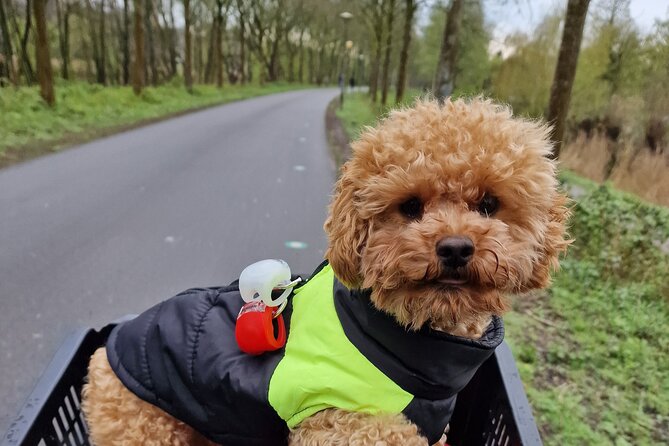
- Herman the puppy is part of the experience: Bill’s friendly dog adds a light, personal touch, though anyone uncomfortable around dogs should keep this in mind.
- You ride beyond the center: The route focuses on Westerpark, Prinseneiland, Houthavens, Amsterdam-Noord, and NDSM Wharf rather than the usual central sights.
- The ferry crossing is included: You take a short trip across the IJ to reach NDSM Wharf.
- You get culture with your cycling: Expect stories about tolerance, land reclamation, architecture, chocolate production, nightlife, and local communities.
- The group stays small: A maximum of 12 people makes it easier to hear Bill and ask questions.
- Bring your own water: A bike, ferry transfer, snacks, chocolate, photos, videos, and recommendations are included, but bottled water is not.
A different side of Amsterdam, starting in Westerpark
This is a good choice if you have already seen the main canals or want your first look at Amsterdam to feel less packaged. The route begins at Waterspiegelplein, near Westerpark, and moves through places that show how Amsterdam keeps changing.
You will not spend the whole ride admiring grand canal houses. Instead, Bill connects the city’s past and present through old factories, reclaimed land, working waterfront areas, art spaces, housing projects, and neighborhood bars.
That focus gives the tour its character. You get a look at how Amsterdam manages water, reuses industrial buildings, and makes room for new communities. The title’s emphasis on culture, liberalism, and tolerance is not just decoration. Bill uses the ride to explain social habits and local ways of living, with an easy style that several guests found clear and approachable.
The route is also practical for seeing a lot in three hours. Amsterdam is flat, and a bicycle lets you cover more ground than a walking tour without spending the whole day on public transport. You should still be comfortable riding in an urban setting, since this is an active tour rather than a sightseeing trip from a bus.
More bike tours in Amsterdam:
- Amsterdam: Guided Bike Tour City Centre in EN/DE/FR/ES
★ 4.7 · 4,187 reviews - Countryside Bike Tour from Amsterdam: Cheese, Clogs & a Windmill
★ 5.0 · 1,485 reviews - Amsterdam: Hidden Gems & Highlights Guided Bike Tour
★ 4.8 · 1,404 reviews
Windmill lessons, a tiny hotel, and a major Keith Haring mural
The opening stops offer a quick introduction to Amsterdam’s unusual scale and history.
Hotel de Windketel is described as the smallest hotel in Europe of the 20th century. The stop takes only about 10 minutes, but it gives Bill a chance to point out one of the city’s stranger architectural details. This is a photo stop, not a long hotel visit, so keep your expectations realistic.
Next comes the large Keith Haring mural on the former Stedelijk Museum depot. Haring painted the work on the building wall, and it is identified as the largest piece of his public art in Europe. You get about 10 minutes here, enough to look closely and hear the story without turning the ride into a museum tour.
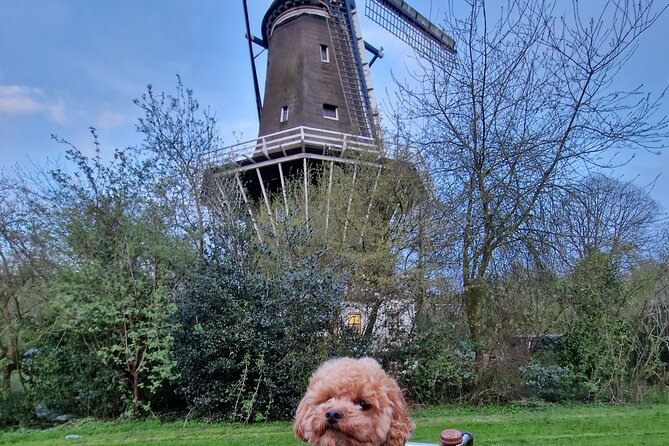
The route then reaches Molen De Bloem, a windmill tied to the basic fact of Dutch life: water management. Bill explains land drainage, reclamation, and why roughly a quarter of the Netherlands lies below sea level. This is one of the most useful stops because it gives meaning to the canals and engineered land you are seeing all around you.
You should not expect long guided visits inside each attraction. The value is in the connections between them. A tiny hotel, a modern mural, and a working symbol of Dutch water control make a compact lesson in how Amsterdam combines old structures with new uses.
Chocolate, nightlife, and the old canal district at Prinseneiland
A stop at the former Tony’s Chocolonely location includes a small chocolate tasting. The company is known for challenging the global chocolate business and producing chocolate without child labor. The tasting is brief, about 15 minutes, but it gives you a pleasant break and a chance to connect a local company with a wider social issue.
The supplied information spells out the company’s ethical purpose, but you should treat the tasting as a small sample rather than a full food experience. It is a nice extra, not the reason to book the tour.
At the Gashouder, Bill points out a former gas factory now used as a major nightlife venue. The building has hosted well-known DJs, including Armin van Buuren, Tiësto, Afrojack, and Martin Garrix. You stop for about 10 minutes, mainly to see how an industrial site has been given a new life.
Prinseneiland changes the mood. This quiet canal district offers the traditional side of Amsterdam without the central crowds. The canals, bridges, and old buildings show a more residential version of the city, where the waterways feel tied to daily life rather than sightseeing.
I would pay attention here to the contrast with the famous central canal belt. You still get Amsterdam’s defining water, but the setting is less concentrated and less hectic. The stop lasts about 10 minutes, so Bill’s explanation matters more than a long period of free time.
The route also passes Haarlemmerpoort, a medieval entrance gate from the direction of Haarlem. The stop is only around five minutes, but it adds a small piece of the city’s defensive and trade history to the ride.
Houthavens and Pontsteiger show Amsterdam changing
Houthavens, once a lumber port, is now an area of new housing development. Bill uses it to explain how former port land can be reclaimed and put to modern use. The result is a useful look at Amsterdam as a city still being built, rather than a place frozen in its historic center.
This stop may appeal to you if you like architecture, planning, and urban change. It is less suited to anyone seeking a long sequence of classic monuments. The tour asks you to notice how land, buildings, and waterfronts are adapted over time.
At Hotel Pontsteiger, you look toward the IJ and see the contemporary square arch-shaped building beside Pontsteiger Pier. The stop is short, about five minutes, but the river setting gives the ride a wider sense of Amsterdam’s geography.
The tour then pauses at Pllek for about 30 minutes. This container-built bar has a gravel beach facing the IJ and offers a snack and drink stop in an informal setting. It is one of the longer breaks, so you have time to sit down and reset before more riding.
The description calls Pllek one of Amsterdam’s hippest bars, which tells you what kind of place to expect: casual, creative, and tied to the waterfront. Since the tour provides snacks but not bottled water, this is a good point to bring or buy a non-alcoholic drink if needed. You should not count on every stop being a full meal.
Same city, a completely different afternoon:
- Amsterdam Classic Saloon Boat Cruise with Drinks and Cheese
★ 5.0 · 31,825 reviews - Amsterdam Luxury Canal Cruise + Unlimited Drinks & Bites option
★ 5.0 · 30,518 reviews - Amsterdam: Heineken Experience Ticket
★ 4.6 · 30,055 reviews - Amsterdam: Rijksmuseum Entry Ticket
★ 4.7 · 25,535 reviews
The ferry to NDSM Wharf is the route’s signature moment
The ride to Amsterdam-Noord and NDSM Wharf is where this experience feels most different from a standard city bike tour. You cross the IJ by ferry, and that transfer is included in the price.
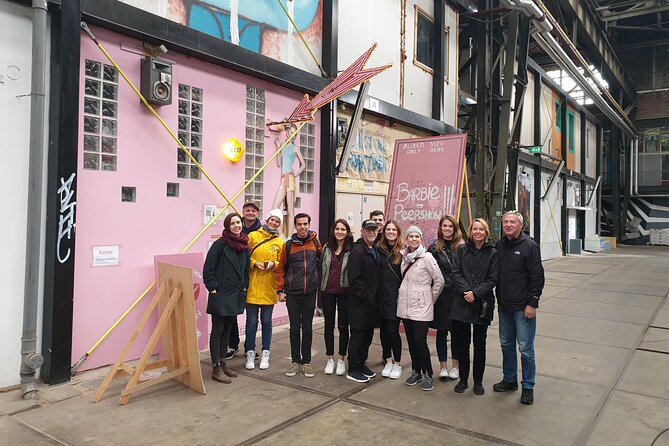
NDSM Wharf is a former shipyard area now known for graffiti, pop-up art, and creative projects. The industrial setting gives the stop a rougher feel than the historic center, and the art changes over time. You have about 30 minutes to look around, making this one of the route’s more substantial stops.
The ferry matters for more than transport. It shows how the IJ separates parts of Amsterdam while remaining part of the city’s daily movement. You get a short water journey, a new view back toward the city, and a clear sense that Amsterdam extends well beyond its central canals.
The Veronica Ship in Amsterdam-Noord is also part of the route. It inspired the film Pirate Radio, adding a piece of popular culture to the industrial waterfront setting. This stop may be especially appealing if you like music history, film locations, and old ships.
One thing to keep in mind is that NDSM Wharf is not a polished museum complex. You are going to an active creative area with graffiti and temporary art. That is part of its appeal, but the experience depends on enjoying open-ended exploration rather than a fixed collection of exhibits.
Museum Het Schip and Amsterdam School design
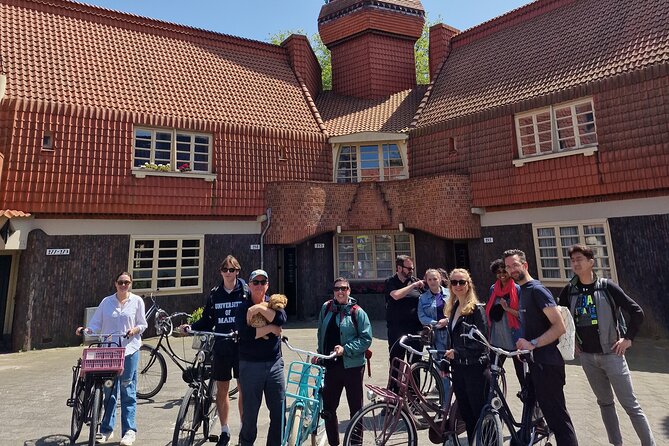
The route includes Museum Het Schip, an iconic 1923 apartment complex with a museum focused on Amsterdam School architecture. You stop for about 10 minutes.
The Amsterdam School movement is known for expressive brickwork and bold shapes, and the building helps explain why Amsterdam’s architecture is more than the grand canal houses found in guidebook photos. The tour connects this local design tradition to Antoni Gaudí, whose work was influenced by similar architectural ideas according to the supplied tour information.
Because the stop is brief, you should think of Museum Het Schip as an introduction rather than a full museum visit. If architecture is a major interest, you may want to return on your own for more time. As part of the bike route, though, it gives you another useful lens on the city’s housing and design.
Finishing with a drink and local recommendations
The tour concludes at Café Pacific near Westergasfabriek, described as Bill’s favorite bar in Amsterdam. You share a drink, hear stories, and have a chance to talk with the guide and the rest of the group.
That ending is useful because it leaves room for practical advice. Bill provides tips and recommendations for the rest of your stay, so you can ask about places that match your interests. The tour is scheduled to end back at the meeting point, even though the final café stop is part of the closing section.
The atmosphere is clearly social, but you do not have to treat it as a night out. The final 15-minute stop is simply a relaxed way to finish a ride that covers a lot of ground.
What the $79.79 price includes
At $79.79 per person, this is not the cheapest way to rent a bicycle for three hours. You are paying for more than the bike, though. The price includes the bicycle, ferry transfer, a small chocolate treat, snacks, photos and videos, and Bill’s guiding and local recommendations.
The ferry alone adds a useful feature that many ordinary bike rentals cannot provide. The small group also matters. With no more than 12 people, Bill can explain stops without shouting to a large crowd, and you have a better chance to ask questions.
I also see value in the photos and videos. One guest specifically appreciated not needing to hold a phone while riding because Bill recorded moments along the way. That is a practical touch, especially on a moving tour.
The value is strongest if you want context and company, not simply transportation. If your main goal is to cycle independently or spend a long time at one museum, renting a bike may suit you better. If you want a guided route through lesser-known parts of Amsterdam, the price is easier to justify.
Weather, pace, and who will enjoy this ride
The tour requires good weather and can be canceled if conditions are poor. You may be offered another date or a full refund in that case. Amsterdam’s weather can change quickly, so bring suitable layers and be prepared for wind near the IJ.
The reviews describe comfortable bikes and a sense of safety helped by avoiding the most crowded central streets. That does not remove the need to ride carefully. You should be comfortable on a bicycle and able to keep moving with a group.
This tour fits you best if you:
- Want to see Amsterdam beyond the main center
- Enjoy local stories, architecture, art, and social history
- Like a friendly small-group setting
- Are happy with short stops rather than long museum visits
- Want a ferry ride and waterfront scenery
- Appreciate dogs, since Herman joins the ride
It may not suit you if you dislike cycling, need a fully indoor activity, want a deep visit to each museum, or prefer a tightly timed sightseeing route with no social breaks.
You can cancel for a full refund up to 24 hours before the start time. The tour also requires a minimum number of participants, so a cancellation is possible if that minimum is not reached. Confirmation is provided at booking, and the meeting point is Waterspiegelplein 10.
Should you book Bill’s Bike Tour?
I would book this tour if you want to understand how Amsterdam works, not just photograph its most famous canals. The strongest parts are the quiet canal district at Prinseneiland, the ferry to NDSM Wharf, the reclaimed waterfront, and Bill’s explanations of Dutch tolerance, land use, and local culture.
The experience also has a warm personal element through Bill and Herman. That will appeal to many people, but it is still a bike tour first, so make sure the pace and outdoor format fit you.
For a first visit, it gives you useful bearings and introduces parts of the city you may not find on your own. For a return visit, it offers a clear reason to leave the central canal belt. At $79.79, I see it as a good-value guided ride for active visitors who want stories, local perspective, and a ferry crossing bundled into one compact outing.
FAQ
How long is Bill’s Bike Tour Amsterdam?
The tour lasts approximately three hours.
What is the price per person?
The listed price is $79.79 per person.
Where does the tour start?
The meeting point is Waterspiegelplein 10, 1051 PB Amsterdam, Netherlands.
Does the tour return to the meeting point?
Yes. The activity ends back at the meeting point.
How many people can join the tour?
The tour has a maximum of 12 participants.
Is bicycle use included?
Yes. Use of a bicycle is included in the tour price.
Is the ferry ride included?
Yes. The transfer by ferry is included.
Is food or chocolate included?
A small chocolate treat and snacks are included. Bottled water is not included.
What happens if the weather is poor?
The experience requires good weather. If it is canceled because of poor weather, you can choose another date or receive a full refund.
Newest Amsterdam write-ups
- Amsterdam canal cruise in open boat – Guided tour★ 4.5 · 126 reviews
- Winter Canal Cruise in Amsterdam★ 5.0 · 12 reviews
- Admission to The Story of Edam Cheese Museum★ 4.0 · 9 reviews
- Amsterdam Ghost Hunt: Self-Guided Mystery Adventure★ 4.5 · 4 reviews
- Amsterdam Treasure Hunt: The Mystery of a Secret Sender★ 5.0 · 149 reviews
- Self-Guided Audio Tour of The Red Light District★ 5.0 · 5 reviews
- Van Gogh Museum Small Group Guided Tour★ 4.5 · 155 reviews
- E-Bike PRIVATE tour Countryside of Amsterdam Volendam Marken★ 5.0 · 3 reviews
Amsterdam Bike Tours, compared.
Countryside Bike Tour from Amsterdam: Cheese, Clogs & a Windmill
Read our review →
Windmill, Cheese, and Countryside E-Bike Tour
Read our review →
Browse the lists this tour appears in